Monday, August 2, 2021

Class Post #3: Psychic Crime Detectives, and Psychics in General: Who is Lying and Who is Not?

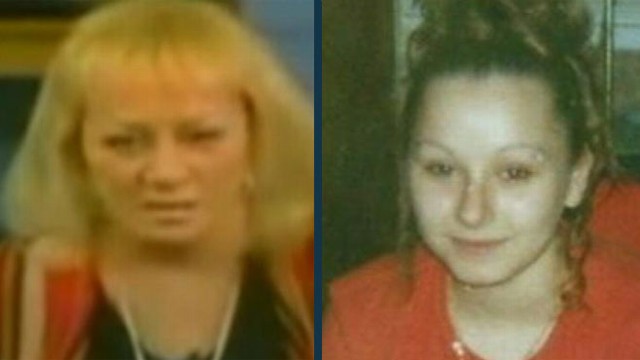
Psychic Who Said Amanda Berry Was Dead Silent After Berry Is Found Alive -  ABC News

                    I’ve always been drawn to those who have shown to have a strong, intuitive sense of knowing, and I didn’t necessarily take into consideration who was being honest with their predictions, and who was just trying to finesse the system and take money from others, and simultaneously telling them something that they already know. It took me a while to use my own discernment to come to the realization that not everyone is honest about their abilities, and there is no way to prove that anyone really has this intuitive and prophetic sense of knowing through scientific explanations since the human mind is inherently flawed, and most “psychics” tend to go off of what they know and what they perceive through body language, gestures, and the behaviors of those around them. In the class, we went over Noreen Renier, and she is a psychic crime detective who receives vague messages about cases she was called to take a closer look at. She does not know how the numbers, letters, and structures in her visions make sense, or are even associated with the crimes and missing persons cases in question, but when her information was applied to cases after all of the evidence was acquired and were nearing to a close, it all started to make sense. Ms. Renier also made it a point to seek the knowledge of a psychic after all other efforts to investigate criminal cases were exhausted, so she knows that her abilities are not the most reliable at all times, but it does make me wonder; if police departments or investigative teams had their own personal and qualified psychic on the team, would that make much of a significant difference. Most likely not, but it is interesting to imagine that being a new occupation. Seeing a job posting for a “Psychic Private Investigator,” would have a lot of people thinking about how easy the money would be. 

                    When it comes to criminal investigators, psychics are not going to be taken nearly as seriously in real-life as they are in films and television shows such as Medium, but this is due to the amount of deception that tends to be associated with individuals who claim to be psychic. There needs to be a way for these individuals to prove their abilities, otherwise there is a lot of skepticism and denial. Now, there are those who have been proven to be liars, such as Uri Gellar, but since he had such a large following, he never lost his notoriety and held onto his fame. His abilities involved a lot of preparation time before going on stage, much like a magician who prepares their magic tricks ahead of time. There seems to be a line drawn when someone acquires a lot of fame, as opposed to someone who is up and coming. Another example of a famous, renowned psychic I can recall from childhood who claimed to have heightened intuition was Sylvia Browne, and she made various appearances as a guest on television talk shows. She did readings on the Montel Williams Show and Larry King Live, but it came out not too long after her death that she was engaging in an immense amount of fraud and even overcharged police departments for her services, if they were required.  Sylvia Browne has a very messy track record, and it goes to show, we need to trust ourselves enough to be able to come to a decision about who is being honest, and who is not. I have no doubt that there are those who have heightened intuition are in fact legitimate, but there is also the concern that there is no scientific proof or evidence of this being a valid and confirmed concept based off of facts, evidence, data, and statistics. There is not enough of a basis for psychics to prove themselves in a profound manner outside of word of mouth, so there is too much room for deceptive practices, financial exploitation, emotional exploitation, and financial fraud to be enacted by the claimant. This is a highly unfortunate reality.  


https://abcnews.go.com/US/amanda-berrys-mom-told-pyschic-sylvia-browne-berry/story?id=19126853

Class Post #2: Subliminal Messaging in Advertisements and Subliminal Self-Help

                     Subliminal messages are defined as, “a signal or message designed to pass below (sub) the normal limits of perception,” (“Subliminal Advertising,” psychologistworld.com), and are typically not seen with the naked eye, or easily perceived from the conscious mind. However, through subliminal messages, advertisers can potentially get through to the unconscious and subconscious minds of those who are viewing of observing the advertisement. Historically, there were a few experiments conducted to determine whether people were affected by subliminal messages in ads, and an American journalist by the name of Vance Packard wrote in The Hidden Persuaders about how movie theatergoers were more influenced to buy popcorn and Coca-Cola after watching the advertisements that indirectly encouraged them to do so. However, this experiment was later debunked by James Vicary, another author who claimed that the experiment was basically a sham, and there was no perceived direct influence on the group of individuals in the movie theater solely through subliminal message. It is also very hard to prove whether or not someone can be directly affected by subliminal messages based off of observation alone. 

                        Due to the nature of these experiments, the FCC proposed that subliminal messaging in advertisements be banned from television and radio broadcasting in the year of 1974. Although this would not necessarily stop a company from utilizing subliminal messaging for the sake of capital gain and encouraging individual consumers to dine at their establishments or buy their products, but when it comes to the denial of an individual’s free will to make choices for themselves, subliminal messaging cannot be implemented in this manner as it is against the law to do so. One thing I do find very interesting about the utilization of subliminal messaging is the concept of subliminal self-help. Subliminal self-help began in 1987 as a way for individuals to come to terms with needing some assistance in their lives, and that may include mental health struggles, self-esteem issues, weight issues, memory retention, and management of their anger issues. Despite the original intentions of the self-help tapes, several exhaustive research studies have concluded that these audio tapes had little to no effect on listeners. The goal was for a listener to feel an illusionary placebo effect that would encourage them to achieve their goals, but instead, there was not even enough proof to determine whether these tapes initiated the placebo effect, and it was exceedingly harder to determine if any changes, substantial or not, were a result of the tapes. It is very interesting how the mind can detect whether or not it is being deceived, even if there is no awareness of deception consciously, and the fact that subliminal messaging only really “works” to the extent that is just outside of the observable frame the human brain can reach. There is no way to know if subliminal messages can inherently decide what one chooses to do, buy, or even if it affects our ways of thinking; but some objects, events, or instances are more impactful depending on how often someone is interacting with them or passing by them in their day-to-day lives, and one can consciously make an association between that item and a message that their brains may be attempting to decode. I find this really fascinating, too, and it gets me thinking about how often the unconscious and subconscious mind work to recollect and recover memories of things we are used to seeing over and over again.  

https://www.psychologistworld.com/influence-personality/subliminal-advertising

Class Post #1: Out of Body Experiences and Astral Projection: Similar, But Not The Same

The concept of out-of-body experiences has always fascinated me, and there is somewhat of an explanation for it through the pseudoscientific perspective, and a more realistic explanation through scientific analysis. OBEs, or out-of-body experiences are defined as instances of disassociation from conscious reality, whether that is induced through the intake of drugs such as anesthesia or psychedelics, significant amounts of brain trauma, or near-death experiences. An OBE is not so much of a deliberate act, and it often occurs outside of one’s immediate control, and this is the significance of the disassociation. Those who can recall undergoing an out-of-body experience did not necessarily feel completely present within their bodies, and there were even individual reports of experiencing significant hallucinations, and a separatism between their bodies and their minds. When I thought of OBE, I also had the concept of astral projection in mind, which is more of a pseudoscientific and esoteric concept that does not have a scientific explanation backed by research. 

                        Although OBEs and astral projection can be classified as similar instances of disassociation and psychological separatism from the physical body, these two concepts are not necessarily one and the same. Astral projection, as opposed to OBEs, is ritualistically prepped for ahead of time for the intentions to undergo a spiritual experience. The intention is to disassociate, or separate from the body to such an extent, that it feels as if one’s soul is coming out of their bodies. I mentioned previously that out-of-body experiences are not planned for, and that would be true since the effects are so intense, and there is no intention to engage in any spiritual-related rituals or preparations. Through astral projection, participants temporarily leave their conscious reality to tether along the “astral planes,” or higher planes of existence where other spirits supposedly dwell. The end goals of astral projection are to achieve a heightening of spiritual fulfillment, or spiritual gain through “ascension.” 


https://cvltnation.com/astral-projections-vs-out-of-body-experiences/

Sunday, August 1, 2021

Viral BS and The Misconceptions of Medical Myths

Now that society lives in a world with conspiracy theories and propaganda, many people are now wary of science and scientists who say they should be trusted. How can people stay sane while unraveling the belief that what they thought was fact turns out to be fiction and now are informed about what they should really be concerned about and what they can laugh off. In her book, Viral BS: Medical Myths and Why We Fall for Them, Dr. Seema Yasmin dissects the biggest medical myths and pseudoscience and explains how misinformation can spread throughout generations and familial traditions. Dr. Yasmin sought to explore the misconceptions and nonsensical beliefs and theories that some people believe purely based on superstitions and curiosity. From basic theories that can raise general research like does playing football give players brain damage, to myths that have no scientific foundation whatsoever, like if your cat’s poops can make you better at business, Dr. Yasmin asks the importance as to why bad science is sometimes more believable and contagious than actual facts.


My favorite part of the book was Dr. Yasmin’s approach to how misinformation can easily spread. Although it's easy to blame these beliefs on people’s ignorance, Dr. Yasmin states that the misinformation can be traced to injustices that have occurred in the history of the medical community and how some people in the medical field do not actively fight against some of these theories and myths because of their own lack of knowledge or communication. This book reflects the topic of mass delusions and hysterias lecture slides handout how easily misinformation can spread. For example, the Salem Witch Trials had no evidence at all that any citizen was practicing witchcraft and invoking demons onto others, however, the sheer panic and believed myths lead to the imprisonment and deaths of hundreds. Even now false medical myths are still spreading at an alarming rate. For example, in the wake of Covid people are claiming that the vaccine can somehow make you magnetic and test this theory by making spoons (which are not even magnetic) stick to themselves. But the question still remains as to how we can combat this spread of misinformation, and Dr Yasmin has taken the first step when addressing these claims and that is to educate others and spread correct knowledge and facts that have been scientifically tested and proven instead of just buzzwords people see on the internet.


Link: https://www.dw.com/en/can-the-covid-vaccine-can-make-you-magnetic/av-57890465


availability cascade and gun control

 In todays society it is very rare that we ever see news outlets ever reporting on happy or uplifting events and topics. In Lou of recent events over the past year, the media outlets have focused a lot on gun violence, police brutality, and gun control. The more that something is spoken about and reported on in a negative light the more it becomes a worry of the people, creating a negative feedback loop. This then sparks movements by politicians to have the upper hand and use these fears to their advantage whether it be in the best interest of the people or just for their own personal gain. 

Over the last decade gun control has been something that frequents the senate and house floor and the debate stage during election season. We now find ourself trying to balance the rights guaranteed by the second amendment and guns being in the hands of unhinged individuals (Jacobs). This negative feedback loop has caused many to focus on the negative impact of firearms and look past the benefits that come along with having the ability to own and use one. Strengthening laws surrounding the possession of firearms will only strip the guns from the honest folks hands, while the criminals and unhinged individuals will continue to get their hands on weapons if they want them through black market trade, and smuggling. This then will leave the honest Americans vulnerable and unable to protect themselves from those who don't currently and may never, abide by the laws set in place. 


https://libertarianinstitute.org/articles/gun-control-guide-major-federal-acts/

Book Report: Viral BS by Dr. Seema Yasmin

Viral BS by Dr. Seema Yasmin is a non fiction book full of medical information that reads as more of a compilation addressing a multitude of  medical myths or common misconceptions with research, science, and style. Each section explores a common claim or question, most related to health in some way, and proceeds to break it down and come to a conclusion about how it started, why people continue to believe it, and whether or not it is based in any truth or if it is completely false. In the case of most sections that address a question, the question is answered in a thorough and slow thinking manner which extracts all possible truths and puts to rest any lies and myths regarding the subject. Some particularly interesting topics discussed include; Can your zip code predict when you die?, Is MSG addictive?, and Do we inherit trauma from our parents? The truth behind these topics and many more are uncovered throughout the course of this book. 

One section that I would have to say is my particular favorite is the chapter titled, “Are Genetically Modified Foods Safe?”. As an Environmental Science major this subject has come up in many classes, and has had a slightly different conclusion in each one. This section of the book addresses many of the things I had heard about Genetically Modified food and has pulled it all together to come to a much clearer conclusion. Dr. Yasmin first defines what genetically modified organisms are; any organisms that have had their genetic makeup altered by anything other than natural selection. This definition then means that almost all foods are genetically modified because almost everything we eat has been selectively bred to be sweeter or juicier or larger. Then she explains that what most people think of as genetically modified organisms are genetically engineered organisms, or organisms that have been directly altered through the use of chemicals or gene insertion. These methods of altering food are relatively new technology, which leads to a stigma because many people have an issue with thinking their food was messed with in a lab. However studies from the World Health Organization, The National Academy of Sciences, and American Medical Association have all concluded that they are safe to consume and have equal to or better nutritional value than non altered food. But the section is not all positive towards genetically modified foods. One counter argument brought up are genetically altered seeds that are resistant to RoundUp weed killer. The use of these crops and other pesticide resistant crops have led to the over use of chemicals such as these that have caused damage to the environment and spawned super weeds that are resistant to weed killer. Now while this is a huge problem, it is an indirect effect of GMOs and not a reason to say that GMOs are unsafe. This section was particularly interesting because of how thoroughly it summed up this debate I have had with myself for a very long time. This section allowed me to critically think about this topic using relevant information and slow thinking to come to a scientific conclusion. The section also highlighted the hysteria centered around GMOs that is largely caused by a poor understanding for what they are and an automatic bias against them because the name implies something unnatural. 

Overall this book covered many different topics that I have heard about in daily life or on social media and because of this book I am able to understand these topics and come to conclusions about them in a slow thinking way. The book will also allow me to address any misconceptions people who I talk to have about them. The book also does a very good job of taking some of the broad spectrum topics we have learned in this class about how to think and what to believe and applied them to medical myths and questions many people will find relevant or interesting. 


Author of this book Dr. Seema Yasmin debunks more medical myths: https://www.youtube.com/watch?v=h-x7M-anEA0 


In a more recent and relevant video Dr. Yasmin debunks myths about COVID-19: https://www.youtube.com/watch?v=bI07A8tW3H0 


The Demon Haunted World by Carl Sagan


Summary: 

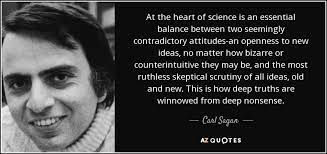
    In The Demon-Haunted World, famed astronomer and scientist Carl Sagan argues the importance of science and critical thinking in the success of the world and everything we do. Sagan elaborates on how scientific illiteracy and lack of critical thinking has led to millions of people falling susceptible to pseudoscience and related beliefs, such as UFOs, aliens, witchcraft, and how this could lead to devastating consequences. He explains the history and emergence of such pseudoscientific beliefs and uses science and critical thinking to debunk these alleged truths. For instance, he details how hoaxes, human fallacies, psychological aberration (e.g., hallucinations), or even a simple misunderstanding of the world may attribute to people falling susceptible to such beliefs. Sagan even provides excerpts from books, newspapers/tabloids, and personal statements from fellow scientists and “witnesses” to bolster his notions/examples. Sagan explains how science is a way of thinking that is both imaginative and disciplined, emphasizing how this balance of creative and critical thinking can improve science, and ultimately the world, as people are open-minded to new ideas and criticize old beliefs/doctrines, thus leading to more scientific explorations that help us better understand the world/universe. 


Favorite Part & Relation to Class:  

    Chapter 8 “On the Distinction Between True and False Visions” was one of my favorite chapters in which Sagan examines the fallibility of human memory, discussing how memory can be contaminated in several ways including hypnosis and false memory implantation.  In this chapter, Sagan explains a few studies regarding memory fallibility/suggestibility in which people, under hypnosis, had false memories implanted. For instance, Sagan mentions a study in which eight subjects were hypnotized and informed they had been abducted and studied by aliens. When asked to describe their experience, the subjects recalled the exact story proposed by the experimenter when they were under hypnosis. Sagan also discusses a case performed by psychiatrist George Ganaway in which Ganaway proposed to a patient under hypnosis that five hours of her memory from a particular day were missing. When Ganaway suggests a bright light overhead, the patient responded by telling him about aliens and UFOs. Still under hypnosis, Ganaway insisted she had been abducted and experimented on, and she responded by detailing an elaborate abduction narrate. In addition to these two cases, Sagan mentioned psychologist Elizabeth Loftus studies showcasing that even unhypnotized subjects can fall victim to false memory implantation. Sagan warns memories are not always accurate and can be contaminated, especially under therapeutic settings through a few cues and questions. He claims the beliefs of the hypnotist/therapist can be communicated to the patient who then misconstrues these beliefs into memories they believe to be accurate and true. According to Sagan, once a key idea is suggested, a patient will more than likely add supporting details. This chapter was one of my favorites as it exemplifies how easily suggestible human memories can be to outside sources and thus, we should be more critical of the veracity of our memories during recall. The chapter also illuminated how such suggestibility can account for why people may fall susceptible to believing in pseudoscientific aspects, adamant that these memories are accurate 

      Reading chapter eight reminded of several class lectures in which the concepts of hypnosis and false memories have been discussed in relation to pseudoscientific beliefs. Lecture seven discusses false memories and how recalled memories are often false; with hypnosis, suggestive interviewing, and leading questions increasing one’s confidence in these false memories and their accuracy. The Florence False Interpretation study details the same findings discussed by Sagan in which clinicians can influence their patients, making patients believe in events that never took place, as people are easily suggestible, especially in therapeutic settings. This specific lecture also included a TED talk by Elizabeth Loftus in which she discusses the fallibility of our memories. Lecture nine connects the aforementioned information to UFO abductions where suggestive interviews and guided imagery (hypnotic or non-hypnotic) can be used to elicit “memories” of being abducted by aliens. Overall, the information discussed in chapter eight and the lectures was quite interesting and an eye opener for me as I learned that our memories can be fallible and so I must be more skeptical in regards to the accuracy of my memories, as well as others, as opposed to taking them for face value. 


Extension to solve a real-world problem or addresses a current issue: 

    The book divulges on how imperative skeptical and critical thinking are in relation the success and evolution of the world for this way of thinking allows us to distinguish real science from pseudoscience. Sagan warned how our lack of such scientific literacy/thinking would be the downfall of not just America, but the entire world, as people are easily fooled into believing alleged truths that have no evidence to support these notions. In today's society, we see how this scientific illiteracy has impacted the world and the people who inhabit it. For instance, we see anti vaxxers, climate change deniers, and people who believe COVID-19 is a hoax. Majority of those who believe COVID-19 to be a hoax refuse to acknowledge the scientific/medical aspects of the deadly virus. As a nation, we need to educate people as much as possible to build more skeptical, critical minds to fight against scientific illiteracy. This can be accomplished by implementing more science programs/classes in schools and giving people easier access to such programs in order to expand their education and scientific literacy.  


Below is a link to an interview in which Carl Sagan discusses The Demon Haunted World. This was the last interview for Sagan before his death in 1996. It is quite an interesting watch.  

Post 3: Graphology

    Graphology, the study of one’s handwriting to determine their personality, is truly an intriguing topic. I had never heard of graphology prior to taking this class but it certainly piqued my interest when reviewing the lectures. I can understand the appeal behind this particular study for it is fascinating to think specific characteristics within our handwriting can illuminate aspects of our personality. If the claims of graphology were true, this would be a fascinating concept and a powerful tool. It still surprises me that people believe this to be a true, effective method in determining another’s personality so much so that corporations throughout the world rely on this method to make personnel decisions. I personally find this to be asinine using graphology as a factor in determining the eligibility of a potential employee. There are plenty of other methods in making such a determination, methods that are far more effective than relying on graphology. I feel it is important for corporations to eliminate using graphology and focus more on other methods, such as psychological tests, to determine whether a job candidate would be suitable for the position.  

For fun, I did analyze my own handwriting with the help of the website provided below and the analysis was fairly accurate in determining my personality. How interesting! Try it out! 

https://www.pens.com/handwriting-infographic


Post 2: Aromatherapy

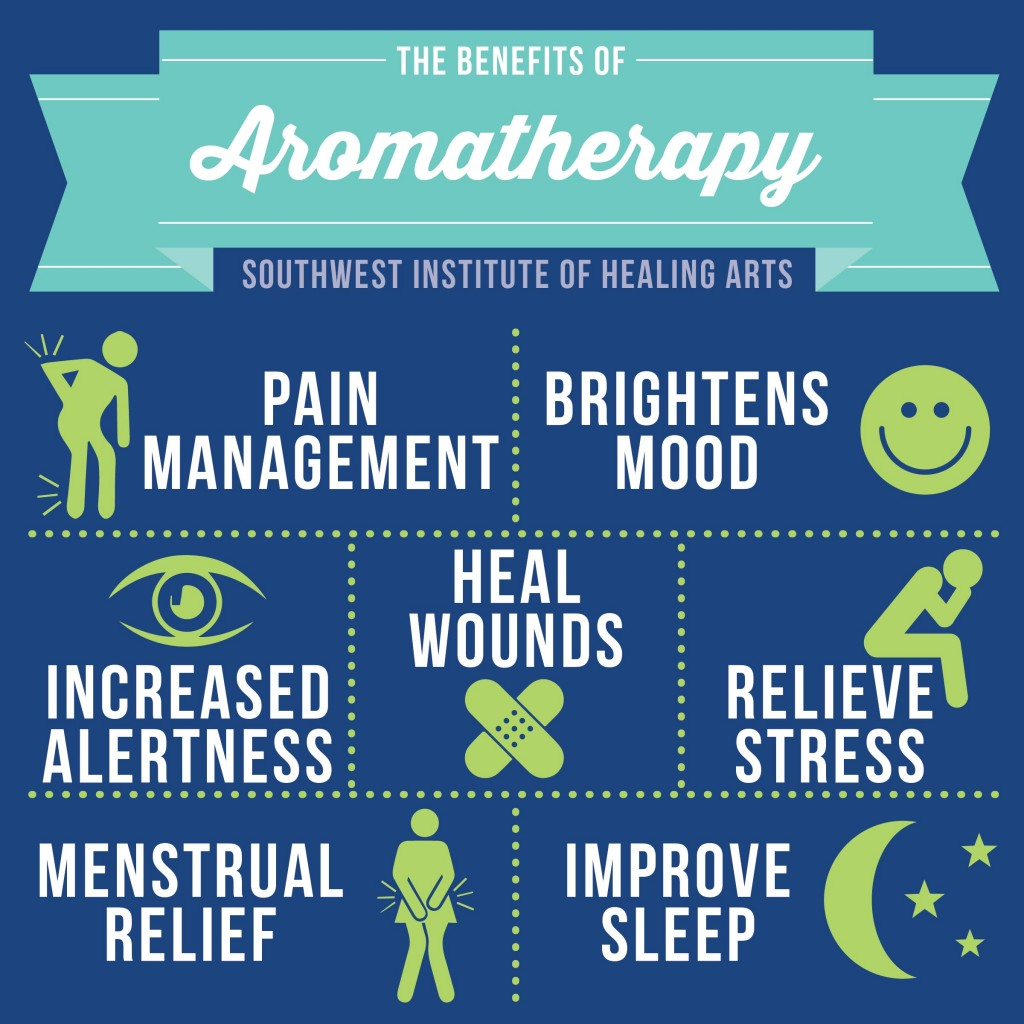
    Prior to reviewing the last lecture, I believed aromatherapy to be an authentic and effective practice. As someone who suffers from chronic migraines and anxiety, I have, on several occasions, utilized different essential oils in an attempt to assuage my afflictions. Majority of the time, using such a holistic healing approach was effective for me and alleviated my pain and anxiety when needed. Several of my family members and close friends have used aromatherapy to treat their ailments and found the approach to be successful as well. In my opinion, this was evidence that aromatherapy was effective (never thinking of researching actual studies examining the effectiveness of this form of treatment). This changed after reviewing lecture ten. Reading the lecture made me question my belief that aromatherapy was a genuine form of treatment. I began to question as to whether this treatment was a trick of the mind in which we psychologically trick ourselves into believing using certain essential oils will alleviate whatever ailment you are targeting. I now believe that the occasions I used essential oils with positive results in alleviating my ailments, may have been all psychological. To think our minds can be powerful enough to impact our physical well-being is extraordinary!  


I found an article discussing aromatherapy and this question at hand.


https://www.huffpost.com/entry/essential-oils_l_5d93a00de4b0019647b010df


Post 1: TED Talk

    The TED talk “The Pattern Behind Self-Deception” by Michael Shermer was a highly informative video, detailing how our innate pattern-finding skills can play a role in our tendency to believe in unusual, pseudoscientific beliefs. Shermer’s discussion of how humans are pattern-seeking, associative learners and the idea of patternicity helped me better understand how the human mind works in relation to forming patterns and even beliefs. The part I found most interesting was the impact dopamine can have on our ability to perceive patterns. Shermer stated a study had discovered meaningful patterns are perceived in the right hemisphere of the brain and not in the left hemisphere; and when given L-DOPA to increase the levels of dopamine in the brain, patients perceived more patterns. In addition, dopamine changes the accuracy in pattern finding such that too little dopamine can lead to one being too skeptical and unable to recognize a true pattern when one is there. Too much dopamine, on the other hand, can result in one seeing patterns everywhere even if some are not real, resulting in madness. Shermer’s discussion of agenticity truly helped me understand how our pattern-finding skills can lead one to believe in pseudoscience such as ghosts, aliens, etc. Learning such information makes me wonder if excessive dopamine combined with agenticity may be the reason a friend of mine believes she has the ability to see ghosts. She, along with her mother, claim to have the ability to sense when spirits are present and can see these spirits. They claim their abilities to see the spirits depends upon how strong the entity is or if the spirits are willing to reveal themselves. Is it possible her alleged “abilities” are real or could it be she has high levels of dopamine in her brain?  Overall, this video was truly fascinating as I learned how not just my mind, but others minds, are incessant pattern-seekers that can infuse patterns with meaning and agency in which we come to believe in pseudoscientific notions. I have gained insight and understanding as to why some people are more susceptible than others to believe in such notions.  

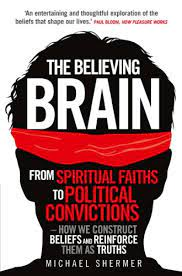
Below is a link to an article written by Shermer in which he discusses further the ideas of patternicity and agenticity and their relation to pseudoscience. It's an interesting read. I also included a photo of the book Shermer wrote regarding this information 

https://www.scientificamerican.com/article/skeptic-agenticity/