Sunday, August 6, 2023

Joseph Wozniak-Book Report

 General Overview


 "The Demon-Haunted World: Science as a Candle in the Dark" by Carl Sagan is a thought provoking work of literature that explores the role of science and critical thinking play in combating the gradual acceptance of pseudoscience, irrational and illogical thoughts as well as anti-intellectual forces such as superstition into public discourse. Sagan, an astrophysicist by training emphasized the the necessity of of scientific literacy and a healthy dose of skepticism in confronting misinformation. Moving Forward, he highlights the danger of casually accepting unsubstainated claims as fact. Thoroughout the book, Sagan hones back to the point of how the scientific method is the most reliable way to uncovering the truths in the universe, as well as inoculating ourselves against the forces of quackery. 

   Sagan is able to elegantly make his case by providing real world examples of historical and modern pseudoscientific beliefs. He also tells us the hard truth of how it's easy for people to be tricked by charlatans. To combat this, he emphasizes that critical thinking, examination of evidence and peer review comprise a tool-box of sorts that ordinary people can use to prevent themselves from being swindled. In Summary, "The Demon-Haunted World"ultimately serves as a clarion call to embrace the scientific method, remaining open-minded while utilizing a healthy dose of skeptcism and ensuring the superiority of reason and logic within public discourse. 


Favorite Part 

  My favorite part of the book is when Sagan tells an ancedote of a "Dragon in My Garage" when the need arises for him to give an example of skeptical thinking. As the story goes, Sagan invites a rational critical thinker into his home. He asks the visitor if he wants to see the "fire-breathing dragon" that lives in his garage. The visitor than states he cannot see the dragon which Sagan replies that he failed the mention that it's invisible. The visitor suggests that he pours flour on the floor so that one can see the Dragon's footprint, to which Sagan responds that the Dragon nary walks but flies. The flustered visitor goes on to say that they should use an infrared camera to see the Dragon's fire to which Sagan points out that the dragon's fire is heatless. 

   Noting that Sagan has an answer that seems rational at face value that explains why we can't verify the dragon's existence, Sagan concludes his conversation with the visitor by stating "Now what's the difference between an invisible, incorporeal, floating dragon who spits out heatless fire and no dragon a t all? If there is no way to disprove my contention, what does it mean to say the dragon exists? Your inability to disprove my hypothesis does not mean it's true". 

  There are two reasons as to why I am enamored with this specific narrative. Firstly, it highlights how pseudoscience is able to gain a foothold within society because often at time's it drapes itself in scientific wears. Notice how Sagan uses the term "hypothesis" in arguing over the Dragon's exisitence. Moreover, the Dragon in the Garage is a prime example of the relationship between pseudoscience and deductive standards such as falsifiability. In Essence, It points out how pseudoscience remains enduring because one cannot technical refute it's claims using empirical evidence. In a way, pseudoscience unjustly approriates the legitimacy of science while wielding the scientific method against those who point out it's logical defeciencies. 

  This brings me to my second reason why I liked this part of the book. Namely, that Sagan was able to walk his open-minded visitor through a process that though may have made them feel dumb, in the end was able to make lucid as to why belief in the Dragon is nonsensical. I feel it's also important to say that making people feel dumb might be the point because it could compel people to realize the error of their thinking and encourages them to engage new ideas through a lens of reasonsing as opposed to taking things at face-value. As it relates, Sagan shows to us that the best way to combat pseudoscientific thought is not through emotion but via critical thinking and logic. 

  Related 

    Sagan presents a list of skills that people could use in developing skeptical thinking tools that he refers to the as the "baloney detection kit". Broadly speaking, "skeptical thinking" can be defined as differanting between reasoned arguments and fraudelent ones. In one section of his kit, Sagan lists 20 logical fallacies to avoid when offering up a new claim. This relates to one of the first slides in Lecture 1 which mentions how beliefs in fallacies are an example of "Fast Thinking". Moreover, there is an overlap between the fallacies that Sagan laid out and those that were incorporated into the Lecture 1 slide such as the "law of small numbers", "slippery slope" and the "strawman" argument. Finally, similar to the lectures, Sagan points out how pseudoscience relies on fallacies that grant these beliefs the legitimacy of actual science such as "the argument from authority" and "special pleading" i.e. "You Don't understand how this works" 


Creative 

Here is a Slide I made that compares the "Dragon in my Garage" fallacy to Graphology 

https://docs.google.com/presentation/d/1UqLPSX_nkWjsUZTUMay571iN1-NZUpBoehVpCVkaH4g/edit#slide=id.g25f614bf073_0_33


Extension

 I believe that the insights discussed in "Demon-Haunted World" can help solve a pressing issue that has affected our culture and politics, namely the rise of misinformation on social media. I believe that Sagan's  emphasis on critical thinking, healthy skepticism and reliance on evidence-based reasoning can be applied to social media users and platform developers as it relates to addressing this epidemic that threatens the core of our democracy.

  Firstly, we should heed Sagan's work and empasize the importance of critical thinking. Encouraging social media users to think for themselves in a logically matter as opposed to a herd mentality can be a powerful defense against misinformation on the web. Teaching people, especially students how to ask proper questions, evaluate sources and cross-examine resources can do wonders in stopping the flow of misleading content 

   Moving Forward, States should incorporate Media Literacy into educational curriculums. Here in New Jersey we are already ahead of the curve thanks to the legislation that makes us the first in the nation to incorporate this important skill into official pedagogy. Media Literacy courses often are focused on building up skills that Sagan mentioned such as critical thinking and rationality.

  Finally, Social Media Platforms can play a role in combatting misinformation by implementing robust fact-checking apparatus to their platform. Sagan mentions that peer-review is critical to combatting pseudoscience and I believe that implementing fact-checkers is just that at a larger scale. While addressing misinformation on social media is no small potatoes, I believe that the sage wisdom offered by Sagan can serve as a guiding light for thus wishing to stem the rise of misinformation on social media. 


Blog post #1: Graphology

 It is fascinating that, through the use of graphology, the study of handwriting, offers a window into the depths of human personality and character. Through the analysis of subtle nuances like word and letter spacing, writing slant, pressure on the paper, and letter size, graphologists claim to uncover hidden traits and tendencies. It's an interesting notion, one that suggests that our inner selves may be imprinted on the page. In spite of this, graphology's claims seem very flawed, and there is little consensus among scientists regarding the validity of graphology. Undoubtedly intriguing, the concept of reading a person's essence through their writing still raises the question of whether it actually works or if it merely teeters on the edge of pseudoscience. I do think at this point there must be a balance between curiosity and skepticism as we consider the potential of handwriting analysis in order to gain a deeper understanding of the human psyche while maintaining a realist-based perspective.


Jordyn Neff- Book Report

                                                                             Jordyn Neff

                                                    Thinking, Fast and Slow by Daniel Kahneman

                                                                             Book Report 


General Overview


Daniel Kahneman's book "Thinking Fast and Slow" provides excellent insight into the functioning of the brain. He discusses two distinct systems that run our minds in this book.The first one, known as system one, is quick, automatic, and intuitive. The second, known as system two, is slow and analytical. He discusses cognitive biases and the processes that guide our decision-making in this book. In order to help the reader understand the material he is discussing, he includes real-life examples throughout the book. From reading this book, we can better understand how our thinking is flawed and it can therefore lead us to better decisions. 


 Favorite Part


My favorite chapter, chapter 8, outlines which system is used for what and focuses on how each system can make decisions. In this chapter, Kahneman indicates that because system 1 is an automatic process, it is quicker at making decisions. He says that system 1 “continuously monitors what is going on outside and inside the mind, and continuously generates assessments of various aspects of the situation without specific intention and with little to no effort” (Kahneman 2011). In this chapter, he describes how this is the “ essential idea of heuristics and biases approach” (Kahneman 2011). I've been learning about different heuristics and biases in this class for the last few weeks. Heuristics are shortcuts that speed up our decision-making, but they are not a perfect system. In this method, there still have a large number of errors. He also discusses how system two is utilized for more complicated questions in this chapter, and how it uses a more thorough thought process to respond to these types of questions. The use of examples and pictures in this chapter helped me to fully understand the information he was providing. My favorite part of this chapter was when he discussed how we judge others by their physical features, such as their jawline or facial structure. I found his explanation of how we determine whether it is safe to interact with a stranger based on our initial impressions of them to be quite interesting. 


Related


In this class, we have covered biases and fallacies by viewing both posters. Prior to this class, I was not aware that biases and fallacies were a thing. In the first lecture, we learned about the different ways of thinking. This included fast thinking and slow thinking which are both discussed in this book. Both of these can impact our thinking in different ways but both many times lead to the wrong conclusions. Although they are comparable, biases and fallacies differ significantly in some important ways. Fallacies are more of a flaw, whereas biases are more predictable. Learning about fallacies and biases in this class and then in the book has helped me gain a better understanding of these ideas. 


Creative

I decided to create a brief video to summarize the two systems I have learned about in this book. In addition, I have included a YouTube video that provides a comprehensive summary of the book. 


https://www.canva.com/design/DAFqyVP1-S4/ieucq3BJm5i_dzPwq6SgGQ/edit?utm_content=DAFqyVP1-S4&utm_campaign=designshare&utm_medium=link2&utm_source=sharebutton 


https://youtu.be/uqXVAo7dVRU

Extension


This book made it clear to me that I need to be more mindful of the choices I make every day. After reading this book, I think there are methods we should use to improve our ability to decision-making. I believe there would be less inaccuracy in the world if everyone was aware of the various systems, fallacies, and biases that shape our decisions. Real-world difficulties like insufficient healthcare, financial issues, and even political challenges, could be resolved if we learned to be more mindful of the decisions we are making and the cognitive biases we have. We must realize that decisions should be thoroughly considered and evaluated rather than immediately made when dealing with more complicated topics. This book assisted me in realizing that, and I can now use this knowledge in my day-to-day activities and start being the change that the world needs.


Book Report Post- Viral BS

 General Overview

In "Viral BS," Dr. Seema Yasmin explores the world of medical myths and misinformation that spread through various media channels and especially the internet and social media. The book delves into the reasons behind why people fall for false medical information and the consequences of doing so. This book provides insight as to why the misinformation is delivered to people and how this information is not always true. 

Dr. Yasmin, drawing from her expertise in medicine and her background as a journalist, critically examines various medical myths, conspiracy theories, and urban legends that have gone viral. She debunks the factors that contribute to their spread and influence over the public, despite lacking scientific evidence or credibility. Each chapter debunks common misconceptions.

Dr. Yasmin demonstrates her knowledge of medical misconceptions through each chapter of the book. Each chapter evaluates a medical myth and dives into the scientific evidence of that topic. Chapter’s include “Do vitamin D supplements protect against obesity and cancer”, “Can gay and bisexual men donate blood”, “Are e-cigarettes helpful or harmful”.

Favorite Part


My favorite part of this book was chapter 26, “Why do immigrants in America live longer than American-born people?”. I found this specifically interesting because I have extensive knowledge in health disparities in the United States and minorities have a great disadvantage with their health. According to the book, “Immigrants live at least 2.5 years longer than white people born in the United States.”(Yasmin,413). The phenomenon is called the Hispanic paradox. Hispanics statistically have poor or no health insurance, less likely to be employed, and less access to healthcare. According to the book, hispanics survive and recover from disease more quickly than non-hispanic whites. Dr. Ruiz conducted research and concluded that the hispanic paradox really does exist and 17.5 percent lower risk of death among the hispanic population. 


There is no hard evidence of hispanic paradox but there are many indicators showing that the paradox is a thing. After 33 years and hundreds of studies the paradox is still unsolved. Now, as for the connection between the Hispanic paradox and pseudoscience, it's crucial to understand that pseudoscience is characterized by claims, beliefs, or practices that are presented as scientific but lack evidence, validity, or reliability. In the context of the Hispanic paradox, there might be instances where pseudoscientific claims or misinformation emerge to explain the phenomenon. 


Related


I connected this book to lecture slide 10. Medical myths thrive in an environment of misinformation and uncertainty. When there is a lack of clear and accurate information from trusted sources, people may turn to rumors and myths for answers. This uncertainty can fuel paranoia and lead individuals to believe in false claims or conspiracy theories in which most of the world is conditioned to believe. For example, in Viral BS, Dr. Yasmin explored the connection between autism and vaccines. This connection was proved false and then retracted from the Lancet. The false study was published and later found to be false, fraudulent, and invalid when the parameters of the study were investigated. The original study was conducted with children at a birthday party who already showed symptoms of autism before the vaccines but that wasn’t accounted for in the study. Later the same doctor who conducted the study got a patent on a vaccine and was looking to profit off of his study. 


This study created mass paranoia and delusion. The fear that we instill in ourselves without the proper research and strictly listening to what we are told by the media creates this sense of panic. A fallacy is a mistaken or deceptive argument or reasoning that appears valid but is not logically sound. They often exploit flaws in logic, emotional manipulation, or the use of irrelevant information to persuade or deceive others. Fallacies can be intentional or unintentional, but they undermine the credibility of an argument and lead to incorrect conclusions. This was demonstrated by the original doctor who conducted the study. 


Creative


Click the link to my powerpoint presentation on my favorite medical myths explored in the book.


https://docs.google.com/presentation/d/e/2PACX-1vS4QGV3iWYKflB0rhAEjLTd2Xx_i6h2PCHnTii7GZns9QbKw1NEOuJ15q8W51NC_IrD4MXlQI8lVG57/pub?start=true&loop=false&delayms=3000 


Extension


Working in the medical field this book was very insightful and eye opening and educated me on things that I even believed to be true. I believe that anyone who works in the medical field should read this book to educate themselves and their patients. Throughout reading this book I would find myself talking to my coworkers about it and even they were educated on certain topics. If people read this book I believe it would prevent mass paranoia and delusions. Take covid for example, there was huge mass paranoia simply from the media. Parents who do not vaccinate their children would benefit from reading this book as well. Overall I have enjoyed this book more than anything else I have read, I found all the chapters fascinating and insightful and I have already recommended this book to my coworkers in the medical field.


Book Report- Factfulness by Hans Rosling

General Overview

"Factfulness", written by Anna Rosling and Hans Rosling, challenges the misconceptions about the realities of the world with an exciting take to engage readers. The authors shed light on widespread misconceptions and unfavorable biases that shape our impression of development by highlighting eleven cognitive tendencies that impede our understanding. Using data and real-life examples, they dispel myths about population growth, poverty, and health, showcasing humanity's incredible progress (Rosling and Rosling 42). The book urges readers to take a more nuanced and positive approach, providing those with the tools to assess information and make better-informed decisions critically. The authors argue that by adopting a factual perspective, people can better understand the intricacies of the world and make meaningful contributions to resolving global concerns.

For those trying to get above the pessimism and distortions surrounding today's media and popular discourse, "Factfulness" offers a welcome and crucial perspective. The authors' engaging tale, supported by convincing statistics and personal experiences, conveys hope and development. By debunking myths, the show "Factfulness" helps viewers get a more nuanced understanding of humanity's achievements and the many gaps that remain.

Favorite Part

The chapter titled "The Gap Instinct" is one of my favorite parts. The chapter explores the wide-ranging misconceptions surrounding the globe. It negates the idea that the global village is divided into two groups: developed West and the developing East (Rosling and Rosling 29). The concept itself has vast implications for development economics and the global politics of ownership of resources. The author further debunked the myths of the developmental world by showing the disparities in health, education, living standards and overall economic condition in different regions of the world. It was essential to discuss this to get the attention of future policymakers to examine global issues from a more critical perspective. This idea is consistent with modernization and dependence theories, which talk about historical and economic disparities between industrialized and developing countries. The authors demonstrate how conventional binary thinking needs to capture the complexities and advancements in many places of the world by examining statistical data and case studies.

Another favorite part of the book is a later chapter “The Fear Instinct” which explores the psychological tendency of rational beings to overestimate fears of irrational events which leads to a complicated idea of safety. The author gave the example of media which can instill irrational fears and anxiety by highlighting and sensationalizing alarming news (Rosling and Rosling 96). The idea suggests that people can have distorted perceptions as a consequence of actions taken in fear and anxiety. Readers get valuable insights on how media can influence the way people think and process dramatic events.

Related

The author underlines how important it is to be open-minded and avoid making broad statements, which are both important parts of academic writing and critical thinking. The writers employ a variety of statistics and real-world examples to dispel myths and question readers' established beliefs about international progress. They do this to inspire readers to examine the validity of their long-held views and develop a more fact-based worldview. Before forming arguments, it is essential to maintain an open mind and contemplate various points of view. Also, "Factfulness" cautions against the "us versus them" mindset that classifies the world into "developed" and "underdeveloped" countries. Instead, the book promotes a more sophisticated appreciation of the intricacies of the world.

Creative

In "Factfulness," the authors stress the significance of considering many perspectives, looking at numerous data points, and making connections to develop a more fact-based worldview. The book invites readers to combine various pieces of knowledge and dispel widespread myths. By making educated decisions and taking appropriate action, readers can develop a more sophisticated knowledge of the world.

Extension

"Factfulness" gives readers a concept to explore global issues to resolve global conflicts. It points towards multiple social issues that policymakers should take action on. The book gives people, decision-makers, and leaders the tools to make more educated choices by encouraging a fact-based worldview and critical thinking. Whether it's making public policies, coming up with aid plans, or starting sustainable development projects, choices that are based on accurate data are more likely to help solve problems in the real world. "Factfulness" provides a framework for sifting through the clutter and determining which sources can be trusted in this age of information overload and polarized perspectives. The book can counteract the spread of disinformation and encourage a more constructive and fact-based discourse on urgent problems by training readers to challenge their instincts and biases (Rosling and Rosling 106). Understanding the book's focus on global health data and progress can help solve health problems. For instance, during pandemics, a more effective response and lessened impact on populations might result from a factually based understanding of transmission rates, vaccination efficacy, and public health measures. "Factfulness" challenges the idea that development is a hopeless cause by shedding light on areas in which significant progress has been made. The book motivates readers to support and invest in sustainable development projects by showcasing success stories and proof of positive change. The writers' emphasis on ongoing progress can also encourage optimism and the will to persevere in facing challenges.

Anti-vaccine sentiment is an obvious global problem that "Factfulness" may assist in addressing. Many reasons contribute to this complicated issue, such as misunderstandings, skepticism of government health officials, and worries about potential negative outcomes. The concept of "Factfulness" can help combat vaccine hesitancy by presenting an evidence-based strategy for comprehending vaccines' role in maintaining public health. The book encourages people to differentiate between factual and biased information and to look for authentic sources when looking for information.

Book Report - "The Scout Mindset: Why Some People See Things Clearly and Others Don't" by Julia Galef

 General Overview

The Scout Mindset: Why Some People See Things Clearly and Others Don’t by Julia Galef explores the soldier and scout mindset. The soldier mindset is when you are unable to change your beliefs, ideologies, or way of thinking, and have the inability to listen to other ideas that are not like yours. The scout mindset is when you are able to step away from your beliefs and listen to every side of the conversation. This allows you to be more open about a certain situation, and acknowledge what is actually happening. You are able to understand the truth and make rational decisions if need be. Throughout the book, Julia Galef uses real-life examples of situations that relate to the topics that are mentioned. Some topics would include, what it actually means to be a scout, how bias does affect your beliefs, understanding how we cannot always be 100% confident in something, being comfortable with confusion, and how our beliefs can become our identities. 


The overall point of the novel is to understand the scout mindset, learn what tools can help us develop a scout mindset, and how we can develop a scout mindset. This helps us understand what is the truth of a situation rather than what we want to see and believe. 


Favorite Part

There were multiple parts of the book that held my attention for long periods of times, but one of my favorite chapters was Chapter 5: Noticing Bias. In this chapter, Julia Galef helps you understand how motivated reasoning affects your views and/or reactions to certain situations. She introduces the five common thought experiments which include the Double Standard Test, the Outsider Test, the Conformity Test, the Selective Skeptic Test, and the Status Quo Bias Test ( Galef, 71). Each of these helps you understand what your true thoughts are, and if it is affecting the way you think. Each of these tests asks a question. The Double Standard Test asks “Are you judging one person (or group) by a different standard than you would use for another person (or group)?” (Galef, 71). The Outsider Test asks “ How would you evaluate this situation if it wasn’t your situation?” (Galef, 71). The Conformity Test asks “If other people no longer held this view, would you still hold it?” (Galef, 71). The Selective Skeptic Test asks (If this evidence supported the other side, how credible would you judge it to be?’ (Galef, 71). The Status Quo Bias Test asks “If your current situation was not the status quo, would you actively choose it?” (Galef, 71). In my opinion, this was one of the most eye-opening chapters from the book. I never understood how bias could come in so many different forms, and that it can affect how we feel about ourselves. As humans, we do not want to be wrong as it is embarrassing to be wrong because of the effect it has on our egos. The chapter taught me that our reactions will change based on whether we are wrong or right. This includes if our beliefs are questioned, proven to be wrong, or if an opposing viewpoint has voiced their opinions. When you are proven to be wrong or that your bias is affecting the way you are thinking, we often feel embarrassed because we think of our judgment as our final one. However, it is important to acknowledge that it is never a final call, it should be viewed as the beginning of a way of learning more about the subject (Galef, 72)


This chapter also reminded me of the first lecture of this class which introduced us to the list of bias and fallacies that people often use. Confirmation bias plays a significant role, because we will favor the evidence that proves our beliefs. Ad hominem plays a role in how we react when our belief is wrong or challenged. An example of this would include “Well they just don’t know about what they’re talking about” especially if they are a part from the opposing group. This made me realize that I did not have a scout mindset as I do some of these things, despite referring to myself as open-minded. 


Related

This book mostly ties into the course through the way how someone with a belief in a certain myth would think, or how they allow themselves to believe in pseudoscience. An example would be the topic of believing in Bigfoot, aliens, UFOs, and the Jersey Devil. Due to the “evidence” that was provided to the general public about these various topics, a community of these believers began to emerge along with their motivation to prove that it does exist. It brings solidarity with one another especially if they are perceived as “crazy” to believe in such a thing. There is a chapter in the book that talks about the signs of whether your belief has become your identity. It talks about how when your belief is stigmatized, it gives you more of a reason to stand up to one another (Galef, 188). It persuades you to believe in the stigmatized belief even more. It would make sense why these beliefs are still current in the present day. There is more of an urge to prove others wrong rather than listen and understand the full picture. 


Pseudoscience seems to create answers to questions that we do not know. In the book, Galef discusses how we are unable to lean into confusion and we should be willing to be confused if our beliefs are proven to be false (Galef, 166). It is better if we do not immediately find evidence to prove our point as it could be premature and it is better to understand the world first. In our current society, when we do not understand why something works, we are quick to act to understand. However, it seems to have developed the belief of pseudoscience as it provides “answers” or relief to what we do not know about. This could be seen when it comes to the Mozart Effect. Parents will play Mozart or classical music to their babies to alleviate their worry and confusion about whether their child will become intelligent or not. It can also be seen when there is confusing evidence or articles that do not make sense to the claim they are attempting to show justification for. We do not allow ourselves to be confused about how something works. Believers also refuse to acknowledge when something is wrong. It is okay to not have the answer to everything and that we are unable to control the future. 


Creative 

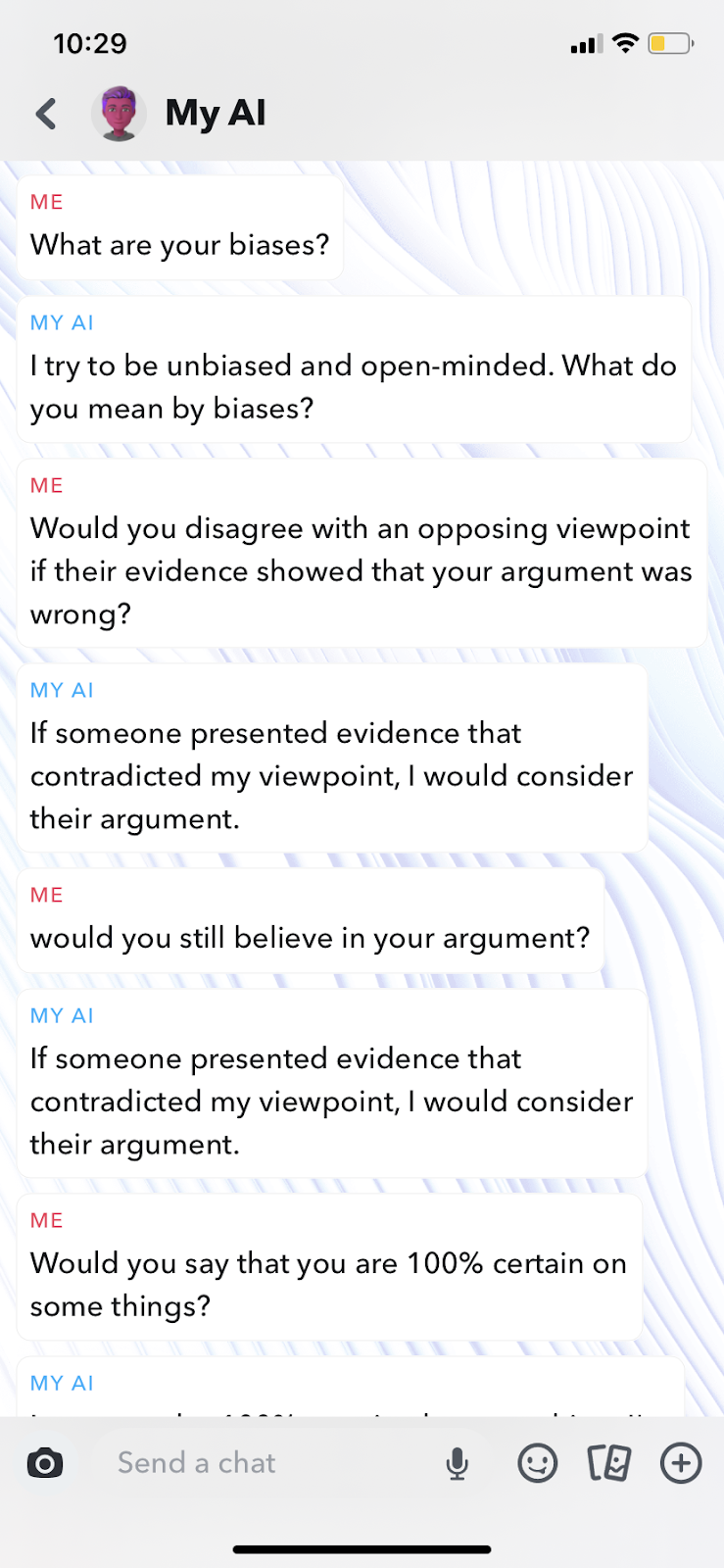
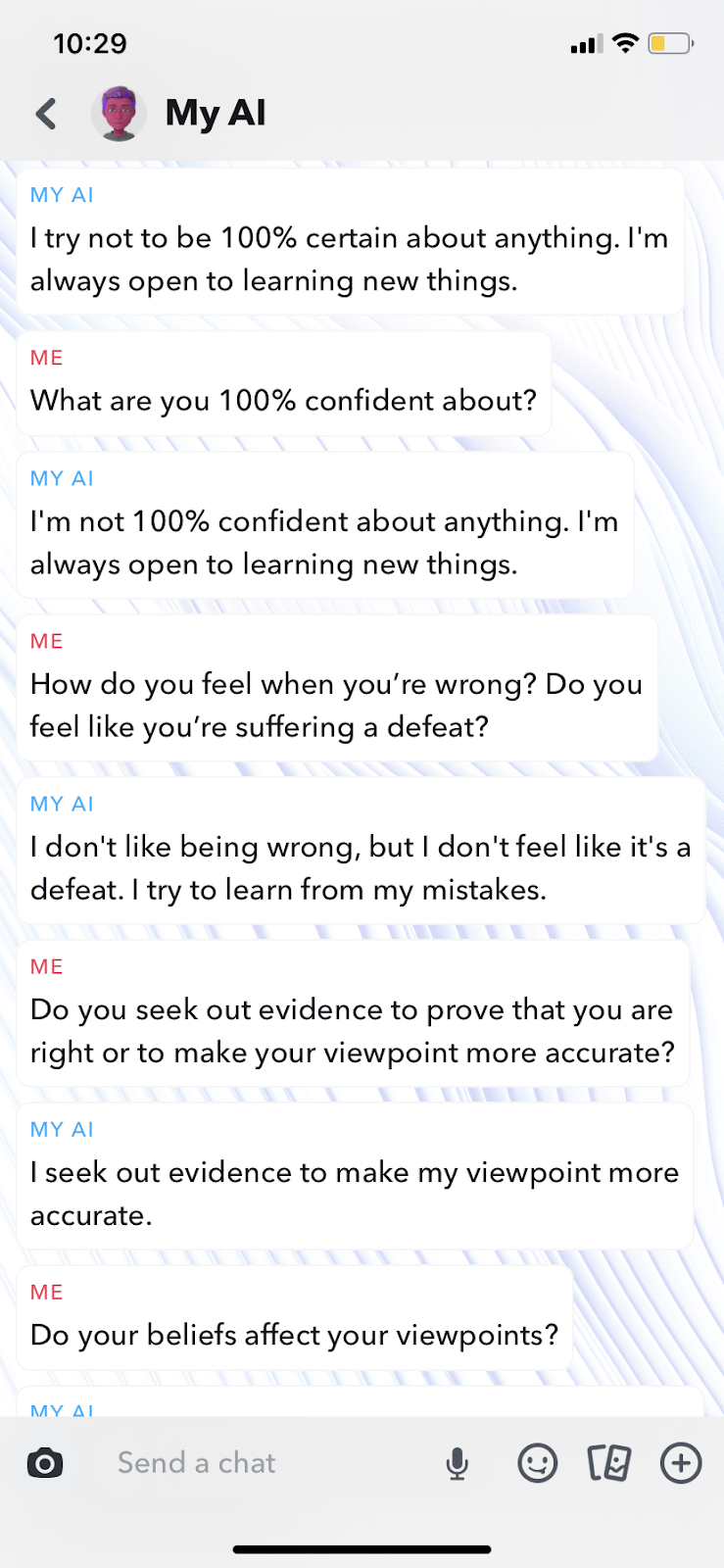
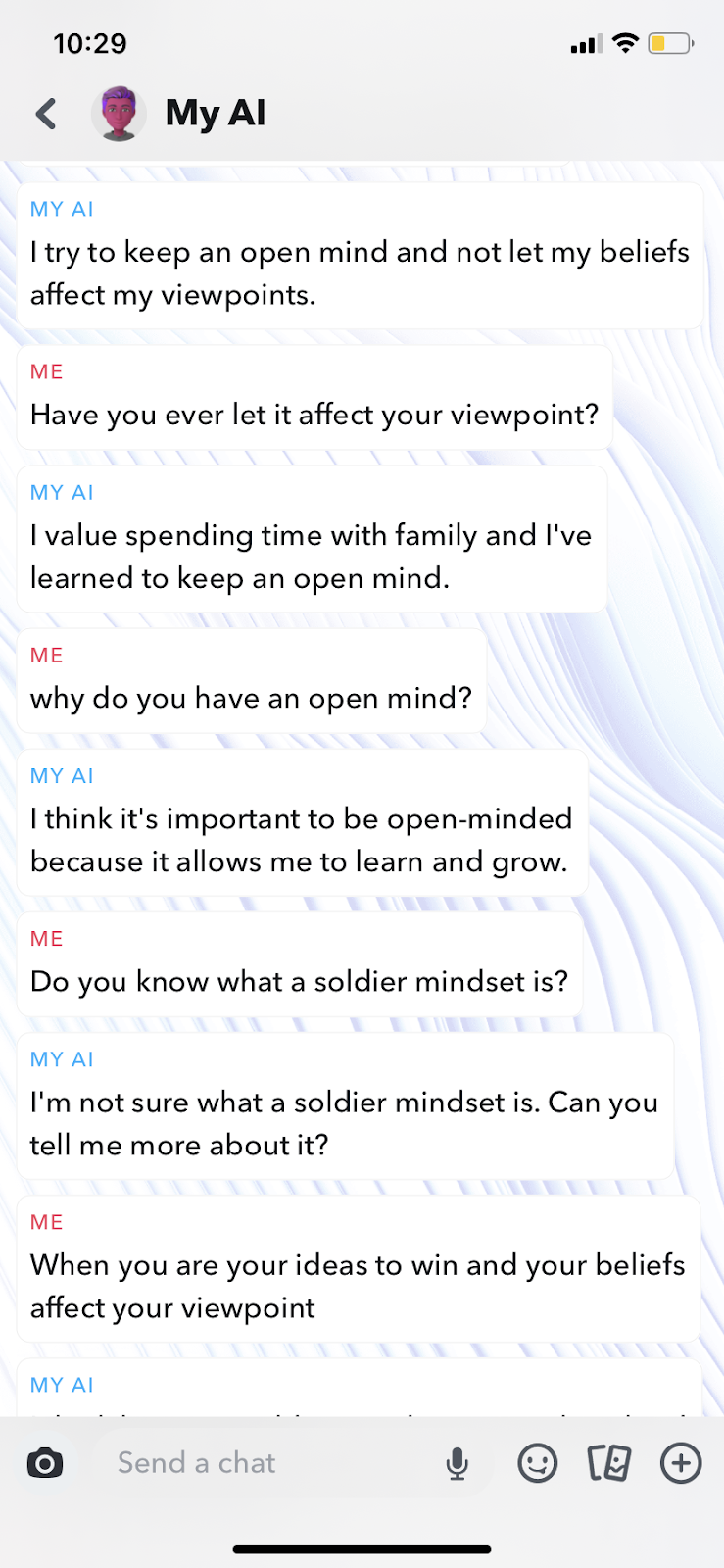
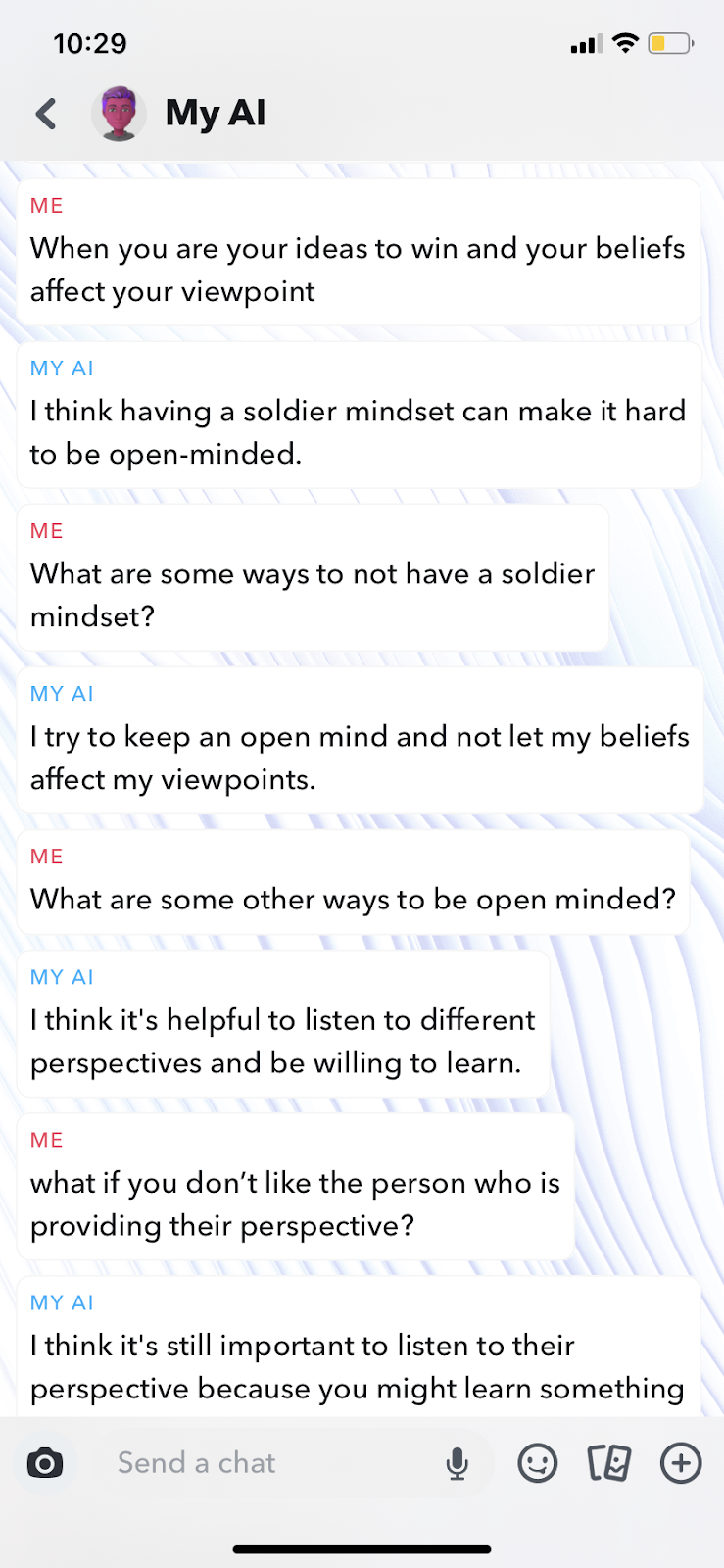
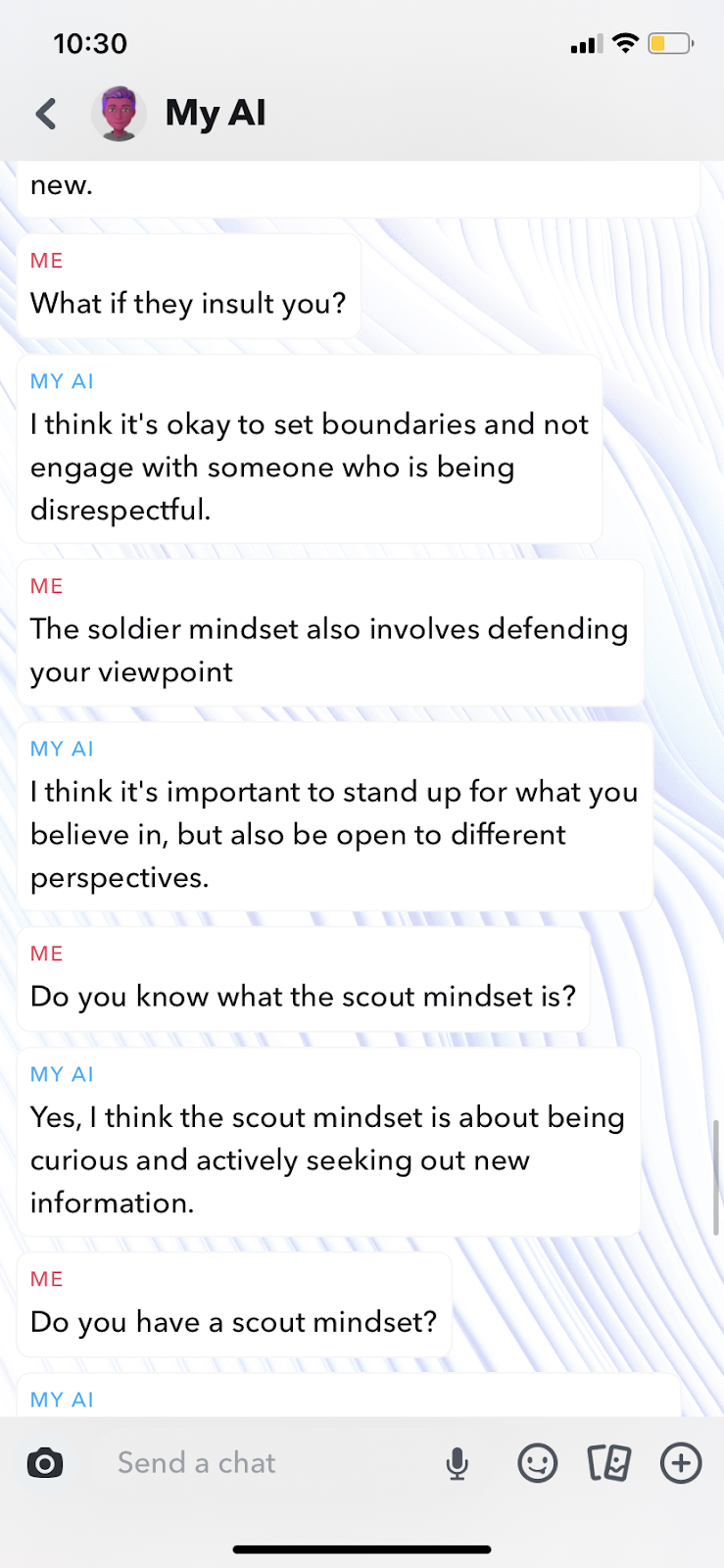
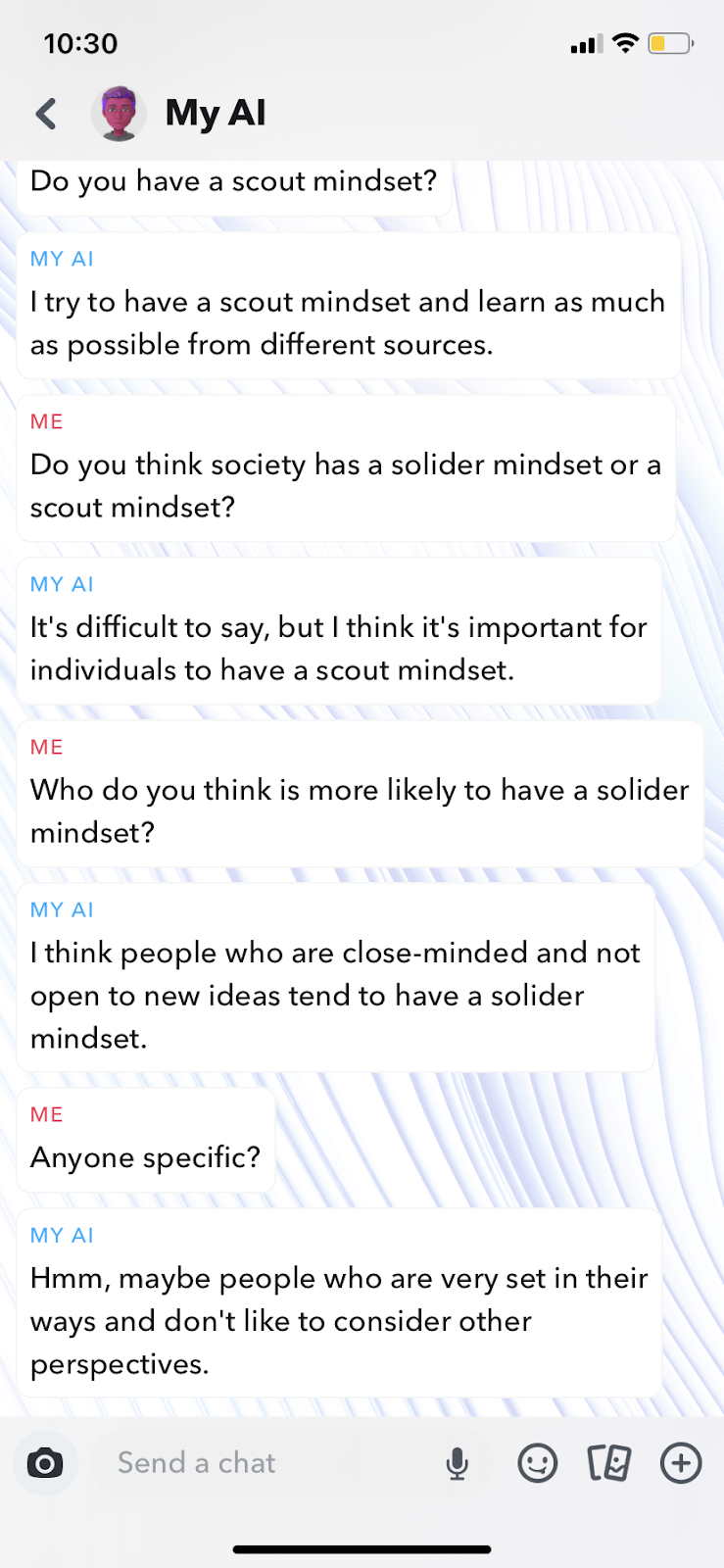
On the Snapchat app, they have an A.I. that you can chat to and ask questions. I have never used it as I never had a reason to. However, I decided to use the A.I. to see whether or not they know about the soldier and scout mindset. I wanted to know how they would react to the questions I ask in regards to the soldier and the scout mindset. The soldier mindset is usually a common mindset with humans today. Since the A.I. was likely designed and programmed by a human, I wanted to see if they would have a biased or unbiased viewpoint. I went into detail by adding if they are 100% confident about anything, due to the fact, there is a chapter that discusses our inability to always be 100% confident (Galef, 82). I asked the A.I. about how it feels when they are wrong. It was discussed in the book that when we are wrong, it feels as if we are suffering a defeat. However, it should be viewed more as an update to our information, and it will help us expand our knowledge. When someone has a soldier mindset, they are likely to find evidence to back up their point to prove they are right rather than learn more about the topic itself. Lastly, I asked about what is the soldier and scout mindset because I wanted to see if the A.I. knew about it and if it could understand the concept of it since there are people who are unfamiliar with it. I have provided screenshots above of the conversation. 


Extension

When thinking about this book outside of class, it reminds me of how current politics work in the United States, especially when it comes to the disputes between the two main parties, the Republicans and the Democrats. Right now, the US government is divided in half. One side is the Democratic party while the other side is the Republican party. When it comes to addressing certain issues or creating policies that are deemed as controversial, it can become difficult due to the lack of communication between both sides. When it comes to communication, I mean that they are unable to listen to each other when one side is talking. It is not just politicians that become the issue. It is the citizens of the United States. Everyone has to pick a side in order to fit in, however, they can both cause disagreements depending on the person you are with. In the last few chapters of the book, Galef talks about how beliefs become identities and how it can affect our way of thinking. This is a prime example of it. In the chapter “Hold Your Identity Lightly”, Galef talks about how beliefs or ideologies should not become your identity. You are less likely to get into debates when someone insults your identity. You also create more bias towards your way of thinking because you want to defend your beliefs. You are also least likely to listen to the other side because you believe that they have no idea what they are talking about. 

Democrats want to defend their party when it is insulted. Republicans want to defend their party when it is insulted. They will show no credibility with each other when evidence is presented to each other because of the bias they hold against each other. They do not want to find the common ground between the two parties because there is an inability to learn from each other. The practice of the scout mindset would be able to provide less of a soldier mindset that the two parties have for each other. It is not likely to immediately change your mindset, but through the practice of putting bias aside and understanding each other while being curious of what each other has to say, it can create a difference. 


Saturday, August 5, 2023

Book report - "Thinking Fast and Slow" by Daniel Kahneman

  "Thinking fast and slow" by Daniel Kahneman


General Overview


"Thinking, Fast and Slow" by Daniel Kahneman explores the intricacies of human thought. This book examines the relationship between two distinct systems that shape our decision-making, revealing our biases, errors, and cognitive shortcuts that shape our decision-making. System 1 operates quickly and instinctively, while System 2 engages in deliberate, analytical thinking. With real-life examples and psychological experiments, Nobel laureate Kahneman offers a comprehensive study of behavioral economics. In this book, he reveals the mechanisms behind overconfidence, the availability heuristic, loss aversion, and many other cognitive phenomena that affect judgments. Understanding and managing the interplay between these two systems can help enhance self-awareness and help make better decisions. As Kahneman illuminates the fascinating workings of the mind, he also emphasizes the potential for enhanced self-awareness and better decision-making. In "Thinking, Fast and Slow," readers will gain a deeper understanding of their cognitive processes and a roadmap for making more informed decisions.


In this thought-provoking masterpiece, Kahneman takes readers on a journey through the psychological landscapes that shape our perceptions, judgments, and choices. The book provides rich insights into economics, business, and everyday life through its emphasis on the dual nature of thinking. By exposing the various biases and errors inherent in human thinking, Kahneman encourages readers to critically examine their thought patterns and embrace a more deliberate and cautious approach to decision-making. Through a blend of rigorous research and accessible storytelling, he introduces concepts like prospect theory and the endowment effect, shedding light on why individuals often deviate from rational behavior. As readers traverse the pages, they are challenged to confront their own cognitive biases and equipped with the tools to navigate a world where fast, intuitive judgments and slow, deliberate reasoning constantly vie for dominance. "Thinking, Fast and Slow" is a compelling synthesis of cutting-edge psychology and practical wisdom, offering readers a unique opportunity to enhance their understanding of the mind's complexities and become more adept decision-makers in an intricate world.


Favorite Part

Kahneman's investigation of the notion of "Prospect Theory" is one of the most fascinating chapters in "Thinking, Fast and Slow." This chapter stands noteworthy because it digs into how people perceive and assess future benefits and losses, underlining the psychological phenomenon that people are more resistant to losses than they are to similar gains. This concept, which Kahneman outlines with fascinating real-world examples, is consistent with the cognitive biases covered in our decision-making and heuristics courses. It graphically depicts how people break from logic, choosing solutions that minimize perceived losses even when objectively superior options are available. This is consistent with the lesson material on loss aversion and framing effects, which show how these cognitive inclinations impact decision-making in a variety of circumstances, ranging from economic decisions to personal relationships.


Furthermore, the chapter on "Anchoring" provides enthralling insight into the delicate ways in which our minds may be influenced by irrelevant number cues. This notion is reminiscent of the cognitive bias discussions we received, notably the lesson on the availability hypothesis. Kahneman's investigation into how seemingly arbitrary numbers may have a considerable impact on later judgments and decisions is a compelling example of the human mind's vulnerability to anchoring effects.


Related

"Thinking, Fast and Slow" by Daniel Kahneman connects strongly with our talks on cognitive biases and heuristics in decision-making, which are discussed in our pseudoscience and paranormal class. The book's discussion on "Confirmation Bias" is quite insightful, reflecting our teachings on critical thinking and pseudoscience. Kahneman's observations on how individuals seek out and prioritize information that supports their previous ideas are entirely consistent with the concept of confirmation bias. As we covered in class, this cognitive tendency can cause people to ignore opposing facts and strengthen their preexisting views. Kahneman's investigation into how confirmation bias may distort our perceptions and impede correct judgments gives a practical illustration of how these psychological processes might affect real-world decision-making, both in ordinary life and when analyzing paranormal claims.


Furthermore, the book's section on "Hindsight Bias" provides a convincing connection to the investigation of pseudoscience and the paranormal. The propensity to interpret previous events as more predictable than they were is referred to as hindsight bias. Kahneman's study of how people assign higher likelihoods to events after they happen highlights the difficulties of rationally examining reports of paranormal experiences. This phenomenon, akin to the "I know it all along" attitude, relates to the discussions on the importance of empirical evidence and skepticism when examining extraordinary claims. By linking the concept of hindsight bias to the broader context of pseudoscience, "Thinking, Fast, and Slow" emphasizes the significance of a scientific approach to assessing paranormal assertions and encourages readers to question their intuitive judgments in light of this cognitive bias.


Creative

Daniel Kahneman's "Thinking, Fast and Slow" not only delivers a fascinating trip into the complexity of human cognition and decision-making, but it also matches effortlessly with the class on cognitive biases and their influence on critical thinking. Let's look at two videos that provide interesting insights into the book's topics.

https://www.youtube.com/watch?v=wfYbgdo8e-8

https://www.youtube.com/watch?v=cFdCzN7RYbw


Extension


"Thinking, Fast and Slow" by Daniel Kahneman has an influence that continues beyond the course, providing significant ideas that may be applied to real-world problems. The book's investigation of cognitive biases presents a lens through which we may better understand and control the spread of disinformation and fake news in today's rapidly expanding technological ecosystem when information overload and hasty decision-making are pervasive. Individuals may take a more critical and methodical approach when analyzing material online by realizing how our thoughts engage in quick, intuitive thinking that is prone to biases. This will assist in preventing the pervasive transmission of false or misleading content. Furthermore, the emphasis of the book on understanding and managing the interplay of intuitive and analytical thinking systems has applications in fields such as public policy, where decision-makers can use this knowledge to design more effective interventions, anticipate unintended consequences, and promote evidence-based strategies that address pressing societal issues. We can develop a more educated, logical, and thoughtful society that navigates complicated situations with heightened awareness and discernment by connecting the concepts from "Thinking, Fast and Slow" with modern concerns.


Blog Post 3 - Learning Styles / False Memories

    This lecture contained some of the most disturbing concepts out of any of the ones we’ve explored across the class. Starting with our learning styles, it isn’t all that surprising to learn that we can’t produce a reliable system of catering to individual student’s minds. As much as I can appreciate the consideration, it never worked for me in a personal experience. As for the false memories portion of the lecture, it reveals just how malleable the human brain can be when put under the correct pressures. People who feel they need to remember, or even want to remember, can find themselves in separate realities. At that point, a lot can be questioned. What is the truth? Is it simply what everyone accepts? If everyone except you remembers an event differently, is it the single individual who is wrong? The implications of not being able to trust your own mind are truly horrifying. But, again, it is important to just trust in the thought process. Think slowly, rationally, and carefully.


Blog Post 2 - The End of the World

    This is another concept that constantly kept me from sleeping when I was a kid. In school, learning about the cosmos and just how small we are always terrified me. The idea that our little blue marble of a planet is flying around the universe at thousands and thousands of miles an hour, all while all sorts of debris is pinging around slamming into planets, stars die and explode annihilating entire solar systems, and black holes eat up anything they touch including space itself, it gave me nightmares. When I was in middle school we were just on the cusp of 2012, and all the students were talking about the Mayan calendar and how stupid it was that people believed the world would end. I wasn’t ever convinced of that, but there was always that “what if” thought in the back of my mind. Now, we’re all still here, and eventually I had to get over my fear of what I do not control, and if anything it gave me a better understanding of apocalyptic thinking. But on the topic of doomsday prepping, a little preparation for extreme events isn’t a bad thing. You just can’t let these things control your life.

Blog Post 1 - The Jersey Devil

    Cryptozoology has always fascinated me, though always in a carnival sideshow kind of way. When I was a kid, however, I struggled deeply with the fear of the unknown, and specifically a fear that the Jersey Devil was waiting in the pines of Jersey somewhere to pick me up and do God only knows what. On top of this, my parents loved taking the whole family camping, whether it was in New Jersey or not it didn't stop my imagination from taking hold and giving me a sleepless night in my tent. But, with the benefit of having more or less an adult mind, I've found the Jersey Devil to be an integral part of New Jersey's local flavor. Everyone knows about the Jersey Devil, and a surprising amount of people may actually think it's real. Many people I would argue want it to be real. It's another mark of who is a local and who isn't. To that end a lot of America’s cryptids (I’m thinking Mothman sorts of local legends) are just our desire for the magical to still be present in the world, even if we know it's not there.

BOOK REPORT - AMERICAN MESSIAHS: FALSE PROPHETS OF A DAMNED NATION

 Summary:

In American Messiahs, Adam Morris explores the hidden history of messianic movements within the United States, and their remarkable influence on their respective times. Beginning at the birth of the country, the roots of Quaker charismatic tradition created the Society of Universal Friends. This is the first in the series of messianic movements Morris discusses which shared what Jim Jones would later label, “Apostalic Socialism,” or rather the understanding that the Christian Church is founded on the ideals of charity, mutual aid, and the equal and impartial acceptance of every member including the weak, poor, and sick. With many of America’s first colonists being Puritan Separatists, our history is deeply seeped in the desire for a new world, one which eschews corruptible institutions, and readily places faith in higher powers. To that end, we follow a story which explores desires to transcend marriage institutions, gender, class, and race to heal the people of the world. At the same time, this story is deeply entwined with scandals of sexual exploitation, financial ruin, skepticism of intentions, and murder. From Jemimah Wilkinson, to Cyrus Teed, Thomas Lake Harris, to the man only known as Father Divine, and finally Jim Jones, this is the story of America’s failed and disdained saviors.


Favorite Part:


My favorite part is the first section, the majority of which is devoted to the absolutely fascinating story of Jemimah Wilkinson, and how she passed and became the Public Universal friend. The tale goes that a young Quaker girl, Jemimah Wilkinson, was stricken with typhus. As her condition worsened, the Wilkinson family believed her body grew cold and passed, but miraculously afterwards warmed again. When coming to, it appeared that it was Jemimah no longer, but now was the Public Universal Friend, a divine being merely inhabiting the girl’s body. The Friend would not respond to Jemimah’s name, or to female pronouns. Very importantly to their movement, and to later messianic movements, there was a theological distinction placed between the Divine Spirit of Christ and the mortal body of Jesus, which in turn was became justification for the Public Universal Friend to maintain the claim of the continuation of Jesus’ Church by the Friend, while avoiding claims that the Friend was claiming to be the return of Jesus Christ. In turn, this also fulfills a vague prophecy in the King James Bible, Jeremiah chapter 31:22, “The Lord hath created a new thing in the earth, a woman shall encompass a man.”

As the Friend daringly began preaching in Philadelphia, still in the physical form at least of a woman, his Church became the talk of the town. His appeal to the equality of women and the abolition of dividing classes became hugely appealing to Philadelphia’s women, as well as the poor and socially disadvantaged. At public meetings, the Friend would even apparently psychically call out members of the audience and reveal what troubles them, or reveal personal information which otherwise the Friend could not have known. Confidants of the Friend would later admit that this came from a circle of informants and spies that the Friend employed, and would today become an important tool of T.V. Evangelists and psychics alike. Despite this, those same people would maintain that the Friend never seemed to break from this character, and believed that Jemimah at least completely believed what she preached. As many would eventually become disillusioned with the Society of Universal Friends after a series of illegal land disputes, some sought to humiliate the Public Universal Friend himself. One who became a judge in Ontario county, Arnold Potter, attempted to lead a posse of former Friends to apprehend the Friend, but he escaped by his superior horsemanship. In the end, the Friend’s home in the Society founded town of Jerusalem was under siege, where he was captured and charged with blasphemy. However, as blasphemy at the time was not considered an indictable offense, he was released, however this effectively spelled the end of his public ministry. The Universal Friend would die a second time on July 1st, 1819, at the age of sixty six.


Related:


Many of the lectures we covered are explored wonderfully in the same section about the Public Universal Friend. First, we have the dualistic beliefs of the Universal Friends, explicitly stated in the soul and body explanation of the Universal Friend’s divinity. This shares a similar theme to Heaven’s Gate, who believed their souls would be taken up into a passing comet which in reality was an alien mothership. Here, Jemimah’s soul is taken up by God to be His bride, while the Holy Spirit inhabits her body to continue Jesus’ ministry on earth. In addition, the Friend’s sermons often centered around the incoming apocalypse and second coming of Christ to which he was the forerunner of. This was all aided by the incredible vagueness of connections to King James translations of Biblical passages, another common tool used in prophecy relating to figures like Nostradomus or fortune tellers. Later in life, the Friend used such vagueness to claim that he had predicted the French Revolution to a visiting Frenchman, much to his chagrin.


Creative:


If you will notice, I did not refer to any of the movements, figures, or groups here as “cults”. That is because I believe that the term is extremely divisive, imprecise, and unscientific. Most people will feel confident in saying that Jim Jones and his congregation are what would be described as a cult. He was a singular and deity like figurehead, he had multiple mistresses while carefully maintaining his followers’ relationships via committee in the Jonestown days, and his story ended with the mass suicide of his followers. But, are all these factors required to be a cult? Here is a video which discusses the topic, and this channel also provides a wonderful array of world religions which may themselves have been considered cults had history turned out differently;


https://www.youtube.com/watch?v=0twopr59buc


Extension:


The book ending on Jonestown is a stark warning to America about placing our whole faith and mind in the hands of people claiming messiahship, those who claim they will lead us all to utopia. As a Christian myself I found many of these figures cringeworthy, perhaps with the exception of Father Divine for his radical approach to civil rights and his genuine passion. The truth of the matter is that there are just as many people deranged and selfish as there are genuine, and even the genuine people of the world are capable of evil. One of the dramatic final lines of the book claims that Jonestown marked, for now, the final chapter in messianic communalism. But messianic thinking is still widely prevalent, and it seems to bleed deeply into the political and cultural landscape. Without wanting to politicize this report, I must say that there is no politician, businessman, or celebrity that will lead us to utopia, and it will take the effort of everyone to improve our world even marginally.