Chapter 3.3: Dream Interpretation and False Beliefs
People are fascinated with dreams and their meanings. A popular theory about dreams was made famous by Sigmund Freud. He believed that dreams hold hidden messages, repressed memories, desires, and even past traumatic experiences. By interpreting dreams, one can tap into one’s unconscious mind and discover the truth. For example, if one has a dream involving blood or torture, one would assume that there are repressed memories of ritualistic abuse.
However, dream interpretation remains unclear. Many scientists today believe that dream interpretation is a pseudoscience that can produce incorrect information which can lead to harmful results. Despite this, many people still believe that dreams hold meanings. There are many books and websites available to guide individuals in interpreting their dreams. Additionally, some clinical psychologists use dream interpretation in their clinical work.
The question at issue is whether clinical dream interpretation is harmful. Does it actually lead to the recovery of a genuine traumatic past? Or does dream interpretation lead people to develop false beliefs or false memories about their past?
Through the Florence false interpretation study, participants had their dreams interpreted by a clinician who interpreted whether their dream can uncover any traumatic experience before 3 years old. It was discovered that participants can be influenced or manipulated to believe that a certain experience had occurred, even when they had originally denied such occurrences from happening. The implications and consequences of dream interpretation are unexpected side effects due to false beliefs about the past.
I believe that dreams do hold some meaning. It is more of a reflection of your thoughts than an interpretation of something far deeper in your life, such as repressed memories of abuse. For example, when I am stressed about school, I often have homework related dreams. This is just a mere reflection of what is troubling my conscious mind, not any hidden meaning of extreme abuse or inner turmoil.
In chapter three of our text, it
discussed the long existing idea that we only use 10% of our brains full
potential. This apparent myth that we use a mere one tenth of our actual
brain's potential has been linked to thoughts that being able to use the other
nine tenths would allow one to harness some sort of super powers. However,
there is no scientific evidence to back up the claim that parts of our brain
simply do not work throughout the day. Actually, there are large amounts of
credible scientific evidence that goes against this ridiculous notion. So why,
then, does this myth refuse to disappear and what has kept it around for so
long?
The
origins of this idea that we only use 10% of or brains are virtually
untraceable. Some early uses of this phrase sprang up in the early to mid
1900s, when the popular director and journalist Lowell Thomas used it in the
foreword of a book he wrote saying, “Professor William James of Harvard used to
say that the average man develops only ten percent of his latent mental
ability,” (p. 53). Then, and even now, it is often been used as a motivational
technique to cater to our human need of self-betterment and is used as a means
for those to “tap into their full potential.”
The
scientific evidence piles up fairly high against this claim though. By using
any form of advanced brain imaging technology, like an EEG or CAT scan, one can
see that there is no part of the brain that is dormant, unless that part of the
brain has experienced trauma and is now damaged. Analyzing the myth from a
basic evolutionary standpoint also allow one to look at this common phrase as a
myth. The human brain is said to have developed over many millennia and is a
very delicate mechanism. I find it hard to believe that over a period of
millions, and possibly more, years, the human brain developed to only use
literally ten percent of its true potential. According to the Triune Brain
theory, the current human brain is actually a combination of three evolutionary
brains. According to this theory, the current human brain consists of the
Reptilian Complex, containing our most primal instincts; the limbic system, our
emotional center; and the neocortex, which serves as the driver, controlling
each of the other two brains. If the Triune Brain theory is correct, and the
human brain is a compilation of three different brains all performing different
tasks in different areas, it is certain to use more that 10% of its true
potential. Below is a picture of the theoretical Triune Brain
I
think this myth has refused to die because humans have an internal sense of
self-betterment in them. We engage in a constant attempt to better ourselves as
a people. This is part of the reason that the self-help industry is such a
successful enterprise for many people. People are always looking to get
motivated about something, and believing that we have the potential to utilize
more of our brains than most people normally do is a way for us to move towards
bettering ourselves. I think most see it as a metaphor or a symbol that tells
us that we have the potential to be better. So even though we don’t literally
use only ten percent of our brain, the harm in believing this myth is minimal,
and keeping it around may actually help people better themselves and be
motivated to be a better person. Even though it is a myth, I think it would be smart
to not kill it quite yet.
Question: we all have heard at some point in our lives that
if a black cat crosses our path its bad luck! But what makes this phenomenal
bad luck?
Information: Black Cats crossing our paths weren’t always
considered bad luck.In fact, ancient Egyptians
held cat’s as scared animals; to kill one was considered a capital crime.It was around the middle-ages in Europe that
the Black cat was associated to bad luck; the reason for this was because at
this time the Catholic Church was attacking these so called witches believing
to be associated with the devil anyone accused of witchery was usually
killed.Europe initially began to
consider females as witches, these females were typically poor lonely and old;
many of which held cats for companionship.For this reason cats began to be associated to bad luck therefore the superstition
began many centuries ago but is still wildly believed by many today.
Inferences: Some people hold the belief that the back luck
can be reversed by doing certain things such as, having a white cat cross your
path.Another way to reverse the curse
of a black cat crossing your path is to first walk in a circle, and then go backward
across the spot where it happened and count to 13.
Point of View: I find it fascinating how a superstition
created by our ancestor’s centuries ago still has an effect on society
today.There is clearly no reason to
believe that a black cat crossing your path is bad luck, this is a silly superstition.
Palm reading has been around for ages, it is a technique in
which an individual claims to be able to read your past present and future,
just from the lines that are located on your hands. Palms are typically unique
to an individual so each person will in theory have a different reading then
others. People seem to use Palmist and Psychics to help them grasp the things
that are going around them, and give them more of a sense of control. It gives
them hope that a love one is waiting for them and they are still love them, or
even makes the feel that their bad luck that they have had is not their fault
but it is luck and it will end very soon. Palm reading offers individuals with
a scapegoat, by saying that because of this line of your palm you are not able
to be in a long lasting relationship, even though there could be many other
explanations why this individual is not in a meaningful relationship. Also they
palm reading claims that changes in your hands line can be attributed to
emotional factors in your life. There is no study of course to significantly
substantiate these claims. According to Wikihow (http://www.wikihow.com/Read-Palms)
on how to read Palms, it explains that if your heart line is breaks at any
time, it suggest that you have been through emotional trauma in your life.This is tough to believe that if you go
through an emotional hard patch that the lines on your palm will start to shift
and change. I used the website to try to read my palm and some of the things
ended up being correct but everyone that was correct there were two that were
wrong. Much like the Q bracelet that was discussed in the book, if an individual
wanted to focus or the correct and ignore the fact most of the information was
incorrect or even vague, they could easily fall for such a pseudoscience.
In conclusion palm reading is probably one of the best
examples of pseudoscience. The entire goal is to take advantage of peoples need
to understand anything what is going on around them. It gives people a false
confidence in their life that the things that are happening to them cannot be
changed because there are greater forces at work. It is suggested that just by
the shape and feel of your hand, you are a cold and stubborn person, if that
happen to be a correct reading, would it really be that hard for that person to
change a little and become more compassionate.
Maria Capelli
First Post
Chapter 3.1 10% Myth
Many times I have heard people say that most persons only use about 10 percent of their brains. If a person is able to use more than that percentage than they most likely have extraordinary talents or abilities that others do not have. If a person could somehow train themselves to access their brain's functions beyond the percent then they could develop extraordinary abilities that they have heard about, such as clairvoyance.
In our assigned reading, there is no clear history of how this myth was created. There is a line from a self improvement book that reads: "Professor William James of Harvard used to say that the average man develops only 10 percent of his latent mental ability. Dale Carnegie, by helping business men and women to develop their latent possibilities, has created one of the most significant movements in adult education." Latent means that something is present, such as our brain, but not active, such as our inaccessible abilities. To me, this statement means that most people do not attempt to develop their latent possibilities, but with the motivation they find through education they will be able to develop more than they could have on their own. It is possible there are some people who will never bother to develop their latent abilities beyond 10 percent. However, I believe most people, especially those enrolled in higher education, have already surpassed that 10 percent threshold. Also, considering the fact that this quote was written in 1956 I believe that the 'average man' currently has a higher percentage of developed latent ability than was previously believed.
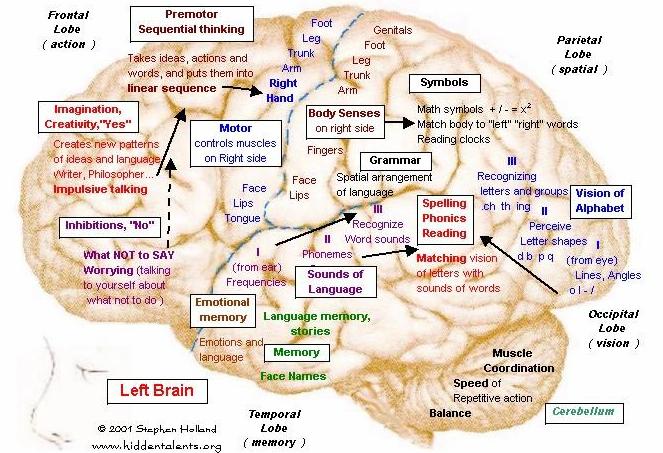
There are so many areas of the brain with different functions and even today they are all still being mapped out. Since 1956 we have discovered that some parts of the brain have more than one function and other parts work together to make functions. We know for a fact we use every single part of our brain, even if we don't yet know for which functions. For each function we perform we most likely use only up to 10 percent of our brain because that's all we need. If we were to use any more than what we need then it would be pointless because the area of the brain that is in use wouldn't assist in the function that is being performed. I believe we use all percentage of our brain, but possibly no more than just 10 percent at one time. This myth seems ridiculous once you look a map of a brain. It also seems absurd for any person to claim that their extraordinary abilities such as clairvoyance are due to being able to access more than 10 percent of their latent possibilities because there has been no research showing that they use any more percentage of their brain than does anyone else. Below is a picture labeling all the function areas of the brain we currently know. Everyone uses every function and 100 percent of their brain throughout their lifetime unless otherwise damaged.
The 10 percent myth remains unproven whether is is meant physically or as a development of oneself as Professor William James made it seem.
What purpose
do dreams serve? Do they play an “adaptive
role" in the maintenance of our bodily or psychological health? Do they
truly express our secret desires? After decades of research and recent develop,
the question now is, do dreams serve
any purpose at all, and if so, what do they mean? Sigmund Freud believed that
dreams were full of hidden meanings. He theorized
that dreams were insights into one’s unconscious mind; they were the revelation
of past traumatic experiences and the exposure of one’s secret desires. Carl
Jung, an early follower of Freud who broke away to develop a very different
theory, claimed that the function of dreams is to compensate for those parts of
the psyche (total personality) that are underdeveloped in waking life. However
a study done by Calvin Hall's two-week dream series from students and longer
dream journals from adults of all ages, strongly suggest that dream content is
continuous with our waking thought and behavior.Some
clinical psychologists interpret dreams
to signal a repressed memory of abuse; For example, a dream consisting of water
may mean that one was sexually abused in a bathing suit.
Since the beginning of time people have
been trying to “decode” their dreams. To do so, they seek advice and information from the findings and
experiments of researchers and dream theorists, as wells as the information in “dream
meaning” books and online websites. From research of my own and taking many
psychology classes, I have learned that when REM sleep was first discovered,
many theorists and scientists believed that dreams only occurred during that
stage. However, we now know that dreams can occurs during any of the four
stages of sleep, but the most vivid dreams occur in the last stage (REM). I
have also learned that a person can have multiple dreams a night; the average
sleep cycle consists of four stages and lasts about 90-120 minutes. Therefore,
it is very common for a person to have several different dreams in one night.
My point
of view on dreams agrees with that of Freud’s. I believe that dreams are
full of hidden meanings and that they are insights into a person’s unconscious mind.
I think the meaning of each dream varies and that it is not fair to say that a
dream about water represents a suppressed memory of being sexually abused in a
bathing suit. After reading about
dreams, I would like to do some research on why people have reoccurring dreams
and how is it possible to do so. Dreaming is fascinating; it’s a unique and
creative side to every individual and is not the same in any two persons. I
wonder if future research will continue to hypothesize and prove that dreams
potentially have no meaning.
There arequestions about
human race and racism as we preceive them in our everyday lives and governmental rules and
regulations. It appears to be rooted in pseudoscience. The misconception of
race has had a great influence on the world as we know it today. There is no
scientific evidence that certain races of people are inferior or superior to
other races or a certain race of people is smarter than another although we have
social practices and laws based on a perceived fallacy of races. Race
classifications were formally (and under some laws remain) based on skin color,
hair type, facial and skull dimensions and body proportions which are physical
or morphological characteristics. These classifications are not based on a biological
or genetic scientific basis.
The cause of these false misconceptions of race in the modern world
has resulted in unwarranted discrimination and considerable human pain and misery.
The existence of different morphological phenotypes does not scientifically
constitute different races or even ethnicity. Cultures may develop specific
systematic human classification systems which are based upon their cultural
beliefs. The need to find differences based on human morphological
characteristics may have had an evolutionary advantage to protect different groups
from other groups; a survival mechanism. The concept of human races appears to
be learned from other humans from their own culture. The culturally practiced
classification system(s) have no biological foundations. Racial discrimination may
have originated as a cultural economic survival mechanism.
Scientific
evidence reveals that races exist only in a context
that there are morphological differences between groups of people as a result
of genetic drift, genetic isolation (in the sharing of similar genetic traits)
and the group’s geographical position on the earth. For example, there is a
misconception that skin color is a demonstration of racial subdivision. Genetic
studies have shown that many dark skinned isolated populations have no common
ancestry and thus are examples of convergent evolution. They evolved under
similar environmental and geographical conditions where dark skin was favored
over lighter skin shade. Skin color is genetically transmitted but is not an
indicator of common ancestry. Lewontin (1972) demonstrated that human genetic
diversity is found within a population and not the overall population. There
are more genetic differences between individuals within a population that share
genetic material than individuals in isolated populations that do not share
genetic material. Thus, the ability to share genetic material in isolation from
another population group causes continuous variation (race) and there are less
genetic differences between individuals in isolated populations.
In my
opinion, perceived differences between
groups are most likely the result of cultural racism which in reality causes
poverty for those economically and socially discriminated against. Of course, by
definition science is dynamic and evolutionary in nature. The results of these
findings are not going to correct the social wrongs committed by one group on
another group. Nor will the masses change their racial opinions of each other
based on these findings, proof of this is realized from the Lewontin 1972 study
which was published forty (40) years ago. This study has received renewed
insight from Spencer Wells, Ph.D., who studied under Lewontin, and has made
great strides in the development of genetic anthropology.
This information is subject to change given the development
of new evidence, hypothesis, theory and experimentation.
Additional
Supporting Evidence: According to Spencer Wells, Ph.D.,
author of The Journey of Man: A Genetic Odyssey (2002) and head of The National
Geographic Genographic Project, current genetic evidence suggests that all human
populations can be traced to the San Bushman tribe living today in Africa.
Lewontin, R. C. (1972). The apportionment of human
diversity. Evol. Biol. 6, 381-98. Print.
Madrigal, L., Barbujani, G. (2007). Partitioning of genetic
variation in human populations and the concept of race. Anthropological
Genetics - theory, methods and applications. Crawford, M. New York: Cambridge
University Press, 2007. 18-35. Print.
The purpose and
research of dreams is to understand dreams and their hidden meanings. You can dream about anything, and anything can
be done in your dreams. There are tools
that can help you interpret dreams.Most
people believe that dreams are “insights into your unconscious mind”.
When dealing with dreams, the question at issue is finding out what your dreams mean.People are interested in why they are having
certain types of dreams and want to interpret them.
Information about
dreams can be found on the internet and in books.I have learned that dreams are usually
insights into your unconscious mind, past traumatic experiences, or secret
desires.I have learned that dreams
usually occur during the REM (rapid eye movement) stage of sleeping, people can
control their dreams (lucid dreaming), it is possible to repeat the same
dream,it is possible to physically or
vocally react to their dreams while they are asleep, and its easier to remember
a dream if sleep is interrupted during the dream.Although there is scientific support to back
up these facts, there are still many things unknown about dreams.
My point of
view on dreams is that no scientist or clinician could ever prove your
dreams to mean a specific thing. A dream
could be interpreted in too many ways to be able to rely on a specific
interpretation. I believe in those facts
that I have stated above because I can validate that those things have happened
to me.I undoubtedly believe that dreams
are either insights into your unconscious mind, past traumatic experiences, or
secret desires; but in my situation, I normally dream about something that has
happened in my past day.
The popular media and self-help industry is rife with extraordinary claims. Alien experimentation, psychic detectives, mediums, ESP, extreme therapies and miracle products are all examples of how pseudoscience and the paranormal have become prevalent, popular and even an extremely lucrative enterprise. The majority of these examples defy the basic laws of science, logic and common sense yet they appeal to a large number of people. Here we will use science, specifically a psychological perspective to explore these popular theories and claims, and learn to think critically in order to be able to constructively evaluate them.



 Posts

