It is easy to assume that people who truly prepared for the end of the world in December of 2012 were crazy. While to an extent I agree, but I also know some very sane people who were pretty uneasy about the whole idea of it (myself included).
I can think of a few people that I know that had an emergency action plan in an attempt to prepare for the end. This included storing food and water, as well as wind-up flashlights and spare clothes. While they might not have gone to the extremes seen in the lectures of those who built bomb shelters, they still wanted a back up plan.
Even I, who in general is pretty skeptical about anything paranormal, was not really sure what to expect in regards to December 21, 2012. Did the Mayans run out of room on their calendar? Was Nostradamus's prediction too vague? I wasn’t sure, but I made sure I was home with my family that day- just incase.
In hindsight, it is all pretty silly how there was so much panic surrounding a single day, after all obviously we all survived to see the next day. But it was pretty insane in the weeks and days leading up to it.
Once sightings of flying saucers or UFOs began to surface in media, pop culture took the idea of extraterrestrial beings and turned it into a franchise. From movies like E.T., Paul, and even an upcoming film titled, UFO (Trailer linked below). Although there is a possibility that the initial UFO sightings were real, there were many more "spin off" sightings that may have been due to a confirmation bias. These individuals may have seen something but immediately attributed it to an alien sightings, disregarding critical thinking to find evidence, or that it could have been something else, something more probable. For example, an individual may have seen a glistening light in the distance but it could just be a drone, plane, helicopter, or it could even be the fact that an individual is having a hallucination. Even though most of the findings of eye witness testimonies of being abducted or seeing a UFO can be easily proven false, I do believe that there are other forms of life in the galaxy outside of Earth. A great satire of Alien pop culture is TBS's People of Earth. Throughout the show, some common links between individuals that believed to have seen UFOs or believe to have been abducted, like sleep deprivation, vivid dreams, or sleep paralysis are mentioned, although it is in the context of actually having been abducted by the aliens in the show. I've linked a trailer of the show, and two funny commercials. (One takes on the common UFO sightings mentioned by many people).
The idea behind some premonitions of “The End of the World”
have focused on vague assumptions on things that could happen years ahead of
their time. For example, the iconic Mayan prediction of the end of the world
happened thousands of years ago and believed that 2012 was the year that the
world would end, but, here we are in 2018 still alive. Another example, as
mentioned in the lecture, was Jeane Dixon's prediction that the world would end between 2020 and 2037. Oddly enough this prediction has such a large range of years which
inevitably increases the “chance” of the world possibly ending. In other cases of “The
End of the World” premonitions, whenever people were wrong about prophecies,
they simply said that it would happen at a different time in the future. For
example, Chris McCann and Harold Camping both believed that the world would end in October of 2011 but when they were wrong, McCann changed the date to October 7th, 2015, again, still no end of the world. With countless of false prophecies, it easy to see how it has become a marketable strategy in today's world. Premonitions, prophecies, and predictions of the end of the world have become heavily used in pop culture today. With movies like 2012, Knowing, This is the End, Legion, or Seeking a Friend at the End of the World, the idea of the, "End of the World," is something that has become fairly common and not a taboo to talk about. The use of the "End of the World" even went so far as to be a part of the Chevy car commercial (Link below).
A cryptid is an animal or creature whose existence has been suggested but has not been discovered or documented by the scientific community. They are found all over the world and some share similar characteristics despite being in very different parts of the globe. For example, the physical description of the Yeti, rumored to live in the Himalayan mountains, bears a striking resemblance to the Bigfoot or Sasquatch which lives in the Rocky Mountains in the Western United States. Another is the numerous reports of lake monsters. One of the most famous being Nessie that lives in Loch Ness in Scotland, but there are monsters with similar descriptions like Champ in Lake Champlain, VT, Tessie in Lake Tahoe, CA, or Shuswaggi in British Columbia, Canada. Though the evidence for these creatures is lacking and unconvincing it is very interesting to get similar reports from such different areas of the world in the pre internet era. The first sighting of Champ(first photo) was in 1609 and the first of Nessie (second photo) was reportedly in the sixth century but was brought to worldwide attention in 1933.
Thinking, Fast and Slow by Daniel Kahneman was unlike any other book that I have ever read. It was interactive at some points and really caused me to stop and think about my own ways of thinking. The book is split into five parts. Part one introduces two systems (referred to as system 1 and system 2 in the book) that Kahneman feels are responsible for all the decisions made by a person. He attributes certain characteristics to each of these systems and explains how they shape our decision-making process. System 1, also referred to in the lecture as fast thinking, operates quickly and impulsively. It requires little effort and we have little control over its function. It is the reason you can detect hostility in someone’s voice, know that 2+2= 4, or finish common phrases such as “you can’t judge a book by its….”. System two, referred to in the lecture as slow thinking, is more deliberate and requires an increased mental effort. Its involved in things such as counting the occurrences of the letter a in this post or focusing on the voice of a particular person in a crowded and noisy room.
Part 2 focuses on heuristics (patterns of thought, or “mental shortcuts”) and biases. This chapter talks about things such as the anchoring effect, the availability heuristic (how personal experience and salience affects judgment). It also covers patterns of thinking that deal with how we perceive others and tries to explain why it is difficult for us to think statistically. Part 3 focuses on how to form ideas and ways of thinking to make sense of the world around us. It talks about the flaws we have when it comes to “going with our gut” and how we cope with the ideas of “risk” and “luck”. Part 4 deals with how we make choices when it comes to financial or economic endeavors, and how fast and slow thinking shape those choices. The final part brings up the idea of our “two selves” consisting of our experiencing self and our remembering self. It mostly deals with how memory or recollection of things can be influenced by a number of factors.
There was a number of different sections and topics I enjoyed about the book so it was hard to pin down one that stood out to me. I would say the most memorable part of the book for me was when this question was asked. We were asked to not solve it, but rather let our intuition take over. The question was…
A bat and ball cost $1.10.
The bat costs one dollar more than the ball. How much does the ball cost?
This question made the idea of system 1 very prevalent to me. My brain instantly jumped to the first answer that made some kind of sense. After reading the correct answer (5¢) I could almost feel system 2 taking over to make sense of it all. The book describes system 2 as “lazy” since it is only really called into action when system 1 needs assistance. This was explained in the first lecture on the ways of thinking. It explained that slow thinking (system 2, critical thinking, etc.) is not the natural state of affairs. It requires work, and a fair amount of mental exertion to perform. Try to watch the following video and count the number of passes made by the team wearing white.
The first time I saw that video I was shocked that I could miss something like that. It was pretty upsetting how the human brain can miss things like that.
Many of the heuristics cause us to fall into a particular way of thinking that is not well thought out or well developed. It could cause us to make snap decisions that might make sense at the time, but ultimately leave us with a less than desirable outcome. It is important that we understand these ways of thinking so we do not fall prey to them. Many others who are well aware of these heuristics arm themselves with them to use them against us. Take this marketing website for example.
While many of the people employing these heuristics might not have cruel intentions, some might. Because of this, it is important to recognize the patterns of thinking that we as humans are susceptible to, that way we can work towards developing critical thinking in all the aspects of our lives.
A false memory is “an apparent recollection of an event that did not actually occur” (“False Memories in Psychology: Formation & Definition”). Recalling past events requires a reconstructive process. People organize the recalling of previous events into what seems logical to them. The recollection of events always meets a person’s expectations. Recalled events are often false and hypnosis does not help memory recollection.Studies have shown that a therapist can make people believe they had experiences they never had through dream analysis. In 1906, Hugo Münsterberg, the chair of the psychology laboratory at Harvard University and the president of the American Psychological Association, wrote in the Times Magazine about a false confession. “A woman had been found dead in Chicago, garroted with a copper wire and left in a barnyard, and the simpleminded farmer’s son who had discovered her body stood accused” (Starr). After police questioning, the farmer’s boy admitted to murder. Every time the boy repeated the tragic events, they grew more detailed.It was “a clear instance of ‘the involuntary elaboration of a suggestion’ from his interrogators” (Starr). Münsterberg wrote to a Chicago nerve specialist about the case and it made the local paper. The boy was hanged a week later. In the early nineteen-nineties, American society was recuperating from another panic over occult influence; Satanists had replaced witches. One case, the McMartin Preschool trial, hinged on nine young victims’ memories of molestation and ritual abuse—memories that they had supposedly forgotten and then, after being interviewed, recovered. The case fell apart, in 1990, because the prosecution could produce no persuasive evidence of the victims’ claims. Elizabeth Loftus, cognitive psychologist, tested her theory of the power of suggestion. She implanted false childhood memories of being lost in the mall as a child. “By the second interview, six of the twenty-four test subjects had internalized the story, weaving in sensory and emotional details of their own” (Starr). When used wisely, suggestion can be an effective tool for good influence. On the other hand, suggestion can severely, mentally traumatize a person.
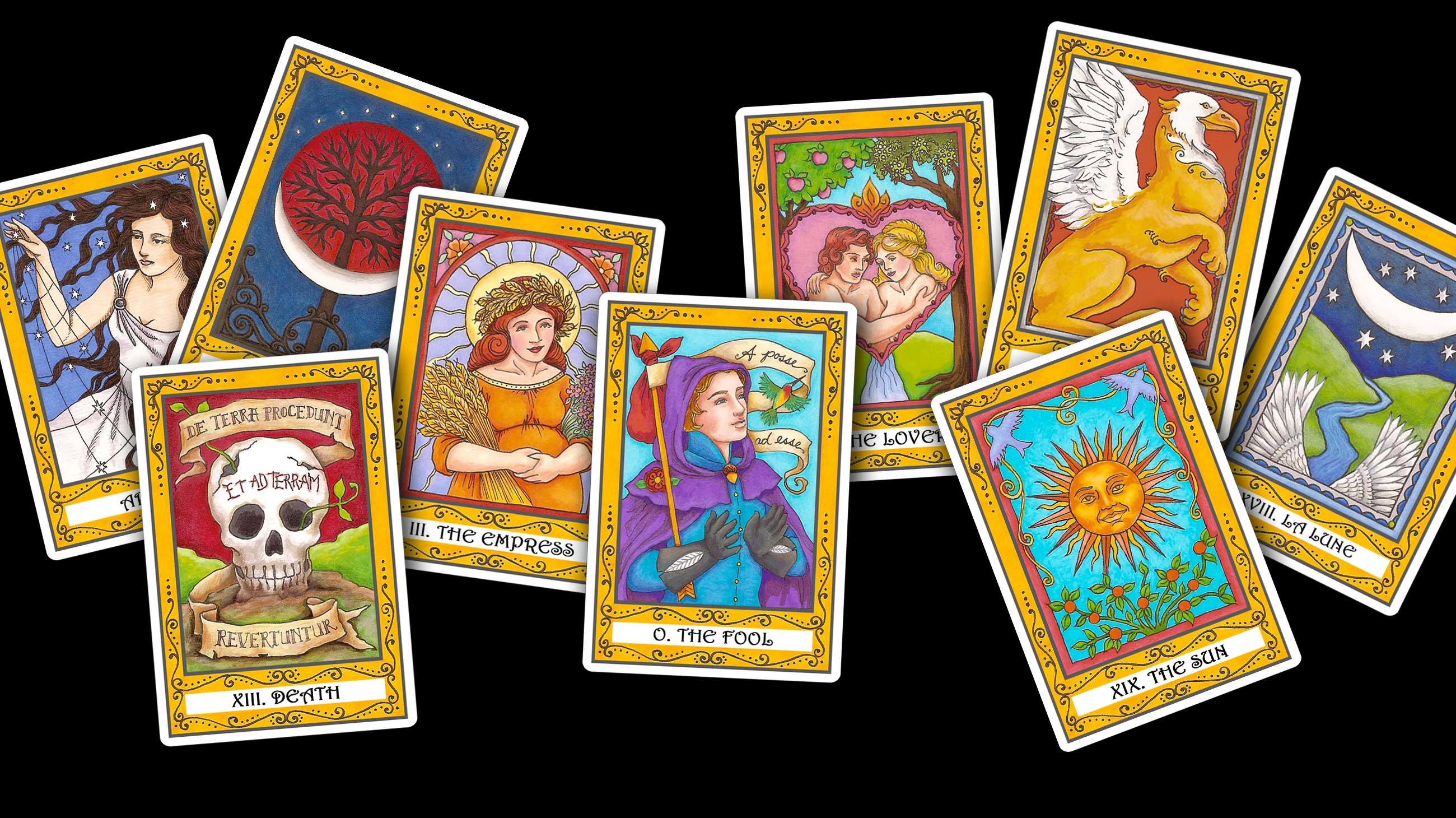
Tarot readings have long been used to try to predict the future
through other worldly means. It uses a pack of cards (traditionally 78) will a
number of different suits and depictions on them. The tarot reader normally tries
to equate some significance of the drawn cards to the users present or future endeavors.
Many of the predictions are not based on the cards at all but a process known
as cold reading. This is a method used by many psychics and mentalist to appear
that they know more about the person that they actually do. It often starts
with the reader probing with some very vague questions or statements. The tarot
reader will then, based on the verbal or non-verbal responses from the person
being read, elicit more information from the person being read. The person being read will then look for ways to apply the generalized statements to specific occurrences in their lives. So, in reality,
most of the information being discussed during the reading is coming from the
person being read, not the tarot reader. There are many techniques used in cold
reading. I got a tarot reading many years ago before I knew about cold reading,
and after learning about it I believe I was duped. I include a video with some
cold reading tips for anyone wanting to try it out for themselves.
Recently, a friend of mine brought this creature to my attention when I was talking to her about this class, so I knew I had to write about it for one of my posts. Cryptozoology and cryptids are one of my favorite paranormal topics, yet I was disappointed in myself for never having heard of Mothman—who is actually really popular! New Jersey has the Jersey Devil, Puerto Rico brought us the Chupacabra legend, and West Virginia has Mothman. The Mothman legend first started on November 12, 1966 when five men at a cemetery who were digging a grave claimed to have seen a “brown human being.” Soon after on November 15 of the same year, a couple driving past a TNT plant claimed to see the creature as well as it followed their car with glowing red eyes. Even more reports of Mothman sightings came in after that, continuing on for quite a while and even being linked to other incidents (and even some supposed UFO sightings).
Most interesting about this cryptid legend, I found, is its popularity. In 2002, Point Pleasant, West Virginia actually held a festival for the Mothman creature, and it is now an annual event. There is even a Mothman museum! Talk about embracing a local legend. The popularity of Mothman led to a book and movie of the same name, “The Mothman Prophecies,” a SyFy channel movie, appearances in video games (“Castlevania” and the Japanese role-playing game “SMT” series), and a number of books. It’s amazing how popular the creature became after its first sighting, and how it continues to be a big attraction even when there is no tangible proof of its existence (besides hearsay and supposed sightings) to this day.
James Randi is no newcomer to the art of smoke-and-mirrors and the mysterious. Once a magician and escape artist, he could fool the believers just as easily as the paranormal still fools the public today, and Randi uses this skepticism to bring many of these common paranormal misconceptions to light. In his book “Flim-Flam! Physics, ESP, Unicorns and Other Delusions,” Randi discusses and dissects many supernatural oddities that had the public going wild with disbelief (and belief), calling upon, and calling out, men of science and academics who allowed these unrealistic ideals to spread.
From fairies to UFOs, astrology, psychic powers and levitation, Randi covers all of the supernatural bases in his book. Each chapter introduces readers to a topic of skepticism and right off the bat goes into name-dropping and debunking. Well researched and well documented, Randi clearly knows what he is talking about, and he has the information to back up his claims. Filled to the brim with knowledge from both personal experience and well-thought discussion with those in the know and those who believe in the unbelievable, “Flim-Flam!” is a book that will definitely make readers think twice about accepting everything they hear about the mysteries of our world. One section of Randi’s book that I found most interesting was the chapter on the Bermuda Triangle. In this chapter, Randi explains how most of the supposed “disappearances” that occurred in the Triangle were really just unfortunate accidents. The planes and ships “disappeared” or went “missing” because, in reality, they likely ended up crashing into the sea and sinking due to faulty equipment or something going wrong with the vehicles. Yet because nothing was found to prove this, people automatically lashed onto the claim that the Bermuda Triangle has some sort of supernatural powers. Out at sea, especially back then, it may have been harder for people to pinpoint wreckage; but nine times out of ten, it was just an accident, not the supernatural. I found it amazing how people still tried so hard to prove that the Triangle was dangerous, grabbing ships and planes and sending them to some unknown dimension. Randi even discussed how some of the appearances that were recorded were made up! I suppose that where the supernatural is concerned, there will always be gullible believers, though.
Many a time throughout this book, it seemed that these so-called “supernatural” wonders could easily be debunked if they were only looked into more. Take the Cottingley Fairies, for instance—which were finally admitted to be a hoax in the early 1980s, how could people believe these fairies to be true? The appearance of the fairies greatly differed from the appearance of girls in the photos. If they were real, the fairies should have had a more life-like quality to their skin, clothing, and expressions. They looked completely 2D, and yet people still believed all the cutouts and camera play to be proof of a psychic phenomenon. True, technology and cameras were not as high-tech then as they are now, so perhaps people were more prone to believe whatever could be caught on photo, but it only takes a keen eye to know the truth in this instance.
Being able to look closely and make your own judgements is useful in the real world too, not just to prove the supernatural wrong. Instead of simply believing what the masses say, use your own eyes and other senses to make sense of the world. If everyone were as skeptical as the people Randi discussed, we’d believe every fake Twitter post and photoshopped oddity out there.
In conclusion, I found James Randi’s book “Flim-Flam! Physics, ESP, Unicorns and Other Delusions” to be a pretty interesting read. As someone who doesn’t really believe in many of these supernatural creatures, places, and incidents, I found myself agreeing with a lot of what Randi had to say. He was very firm in his opinion and there was no sugarcoating of the cold, hard facts in this book. If you are a believer in the supernatural, though, Randi’s book might not be for you—he tended to be pretty harsh in his assessments!
If you find yourself still interested in some of his claims and paranormal debunking as I was, there are a lot of great videos of him in action on YouTube and elsewhere! I found this particular one quite intriguing after reading the lecture involving psychics. Have fun!
False Memory
After listening to the presentation on false memories in our lecture notes, I decided to do a little research. Apparently, we can not believe our own memories. This is what the reader is told from data collected by top scientists and researchers in the field of memory study. A false memory is a psychological phenomena where a person recalls events that did not happen. Initially investigated by a man named Pierre Janet and Sigmund Freud and further researched by Elizabeth Loftus. She has bee a leading researcher in this field since 1974. Her main focus of study is memory recall and false memory. She claims that false memory can have minimal effect on a persons life or can advance into what is called false memory syndrome.This syndrome can have profound effects on a persons mental state (https://en.m.wikipedia.org/false memory.) According to an article in Scientific American, every memory we have is full of errors. Our recollections may feel real when sometimes they never really happened at all! It seems our brains only retain very small bits of events we have experienced. Every time we recall a memory, it may be changed from the last recollection. This raises the question, what can we believe? According to Annelies Vredeveldt, a memory scientist from the University Of Amsterdam, do not ask any questions of a person until they are finished speaking especially not leading questions such as, Was his hair blond as this may create a false memory (Shaw, J., 2016). Chris French from the University of London has done decades of research on paranormal memories and believes them to be false memory. He states that memory is not like a video camera. We generally do not recall exact details. We tend to fill in the blanks with what we believed to have happened. We may also have memories of events that never occurred. This can result from unethical therapy. Mr. French also wanted his readers to know that there is no evidence to support memory repression although it is widely accepted (Shaw, J., 2016). Current research indicates that there is no way to determine whether a memory is real or not! Scary! So, the next time you argue with someone about a shared memory remember, neither of you may be right. I won't tell my husband that.
References:
Shaw, Julia. What Experts Want You To Know About False Memory. Scientific American, July, 2016
Unidentified Flying Objects, better known as UFOs have been around for a very long time... It is believed that there is extra life outside of our own. UFOs have been spotted all over the world and it would not be surprising if there is life outside of our own. The first really recorded UFO siting was in 1947 by a man named Kenneth Arnold. He explained that as he was flying a small plane, multiple high speed objects that looked like saucers, fly past him in the state of Washington. This is when the term "Flying Saucer" came about. As time moved on more and more people started to report sightings of UFOs... There were so many sightings that in 1952-1969 they compiled over 12,000 reports of ufo sightings. all of this was compiled by the US Air Force and was known as Project Blue Book. It is even said that Area 51 holds UFOs as well as aliens but there is no solid evidence. Me personally I believe that there is other life outside of our own. but it is hard because I have not seen anything to prove it in my own eyes. Down below I have a link that shows a military jet that has possibly spotted a UFO, pretty interesting.
“Déjà Vu” is a French term that translates to “already seen”.
It was coined by French scientist Emile Boirac in 1876. It is a period of 5-30
seconds where the person has a sense that they know what is going to happen
next or that they have already experienced the current moment in time. This
phenomenon has yet to be studied in depth due to it occurring so sporadically
and unannounced. This has led to many wild theories about what causes it. Some
people believe that those who experience déjà vu are more in tune with their
ESP (extrasensory perception) abilities. Some say that this phenomenon is due
to having live this life once before, and the déjà vu feeling is due just some remnants
of memories left from that. The most widely accepted theory is one created by
Robert Efron in 1963 and is referred to as “dual processing”, or “delayed
vision”. This theory takes into account the way our brain processes information.
He believed that if the time between when the brain receives information and it
is processed is delayed longer than normal (milliseconds), this will result in
the information receiving the wrong “timestamp” and will register as a previous
memory rather than something currently happening. There is a lot more involved than that but that is the general idea of what he believed.
If you’re interested in reading more in depth about Robert
Efron’s theory, he wrote a scientific article titled TEMPORAL PERCEPTION,
APHASIA AND DÉJÀ VU.
The popular media and self-help industry is rife with extraordinary claims. Alien experimentation, psychic detectives, mediums, ESP, extreme therapies and miracle products are all examples of how pseudoscience and the paranormal have become prevalent, popular and even an extremely lucrative enterprise. The majority of these examples defy the basic laws of science, logic and common sense yet they appeal to a large number of people. Here we will use science, specifically a psychological perspective to explore these popular theories and claims, and learn to think critically in order to be able to constructively evaluate them.




 Posts
Posts

